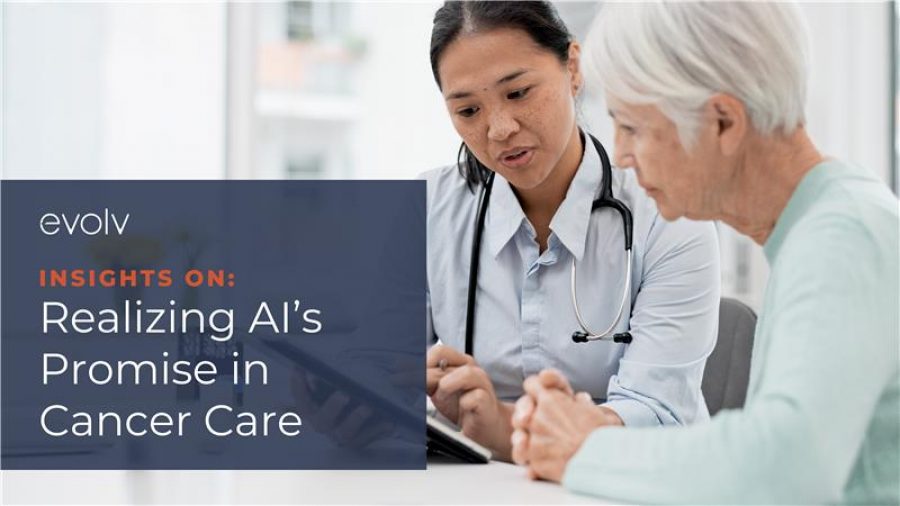
Technology has always played a role in improving healthcare, but today we’re standing on the edge of an entirely new frontier. Artificial Intelligence (AI) has the potential to transform how we detect disease, predict risk, personalize treatment, streamline healthcare workflows, and improve outcomes in oncology. And yet one truth remains:
AI cannot fulfill its promise in cancer care unless clinicians believe in it.
The 2025 Advancing Community Oncology Report highlights this confidence gap clearly. While over 80% of clinicians expect AI to have major influence across cancer care in the coming years, a majority also acknowledge that they are not fully ready for these rapid changes. Technology is advancing faster than our systems, regulatory frameworks, practice operations — and, importantly, faster than trust.
This isn’t a resistance to progress. It’s a reflection of something essential: In healthcare, trust isn’t a soft factor. It is a clinical requirement.
Trust Is the Foundation of Care
Patients place profound trust in their clinicians. That trust keeps them engaged through painful, confusing, and often frightening decisions. When AI enters the room — in the exam, in treatment planning, in clinical workflows — it requires clinicians to place trust in technology on behalf of patients. But that trust must be earned.

In oncology, decisions are high stakes. A flawed algorithm isn’t a minor inconvenience; it could delay a diagnosis or compromise survival. Clinicians need to know:
- Where did the data come from?
- How does the algorithm learn, govern, and correct itself?
- How is bias prevented?
- What happens when AI contradicts clinical intuition?
- Who is accountable?
Clinicians are held to high standards. AI adoption will only accelerate when clinicians feel that the technology operates with the same rigor, ethics and transparency that they do.
The Emotional Reality of AI Adoption
We often frame AI enablement as a technology challenge — training, workflow integration, and data interoperability. Those are critical.
But the emotional reality matters just as much. Clinicians fear losing autonomy and worry about being held responsible for decisions influenced by AI. Many question whether AI will increase their workload instead of reducing it, and others wonder if technology is replacing relationships with data.
As someone who spent more than 15 years responsible for clinical operations, quality, and talent development in healthcare, I’ve seen firsthand how trust determines whether innovation succeeds or stalls. Change management isn’t only about adoption. It’s about confidence and conviction.
Here’s what will move trust forward:
- Clinician-Led AI Governance: It’s vital that oncologists, nurses, and pharmacists are included in AI design, implementation, and monitoring. Clinicians must be co-owners of the solution, not end-users of a black box.
- Transparency, Not Mystery: Clinicians need details. AI must provide explainable outputs and visible evidence behind recommendations. Surface why the AI suggests something, not just the what.
- Workflow Support, Not Workflow Burden: AI must lower the cognitive workload by simplifying things like documentation, prior authorization, and trial data matching. Technology should give clinicians back time to the bedside.
- Education That Respects Expertise: AI must offer peer-led learning and real clinical case examples, and continuous feedback loops for refinement.
Why Trust Matters Most For Patients

Ultimately, this conversation isn’t just about technology readiness — it’s about patient readiness.
Cancer patients need their clinicians confident in every decision made on their behalf. They need clinicians who embrace new tools because they trust them, not despite their doubts.
AI will change oncology care. But it won’t replace the clinical reasoning, empathy, and judgment that defines excellent care.
The future of cancer care isn’t AI vs. clinicians — it’s AI + clinicians delivering better outcomes together.
To get there, we must invest as much in trust as we do in technology.
Closing Thought
Innovation doesn’t drive trust. Trust drives innovation.
If we build AI that clinicians can trust, they will champion it. Patients will benefit from it.
And the promise of AI in cancer care will become reality, equitably and sustainably.