
By Mike Henry
Timing is everything in the tournament gaming economy. Players enter competitions expecting instant gratification – seamless matchmaking, real-time leaderboards, immediate payouts. But behind the scenes, many tournament platforms we work with are still running their operations on batch reports that arrive hours or even days after tournaments end.
The gap between player expectations and operational reality creates measurable problems like delayed fraud detection, missed monetization opportunities, and an inability to optimize tournaments while they’re happening. As mobile gaming reaches commoditization — and competition intensifies — platforms that master real-time tournament intelligence create differentiation that’s hard to replicate.
Here’s how evolv is helping tournament gaming platforms transform from reactive batch reporting to proactive real-time operations, delivering 12% improvements in key metrics and 2X operational capabilities.
A quick note before we dive in: A video embedded in this post provides a quick look at how evolv leverages Snowflake Cortex Code to spin up business outcomes quickly for our clients. We can deliver a true demonstration of tailored solutions just like this to solve your business problems. If you like what you see, reach out!
Why: The 700% Problem
The Problem: Tournament platforms operate in a paradox, as they deliver real time gaming experiences to players while managing operations on stale, batch-processed data.
A whole host of problems can arise when tournament data arrives hours after matches end. Player experience issues like matchmaking imbalances and technical problems surface too late, leading to a drop in engagement. Platforms can’t adjust entry fees, prize pools, or incentives during active tournaments, and game developers can’t see performance metrics until tournaments complete. Meanwhile, bad actors can exploit vulnerabilities for hours before being detected.
The 700% Lag Effect: When tournament operations run on batch reports, decision making lags reality by 700%+ of tournament duration. A two-hour tournament generates actionable insights more than 14 hours later, when the next tournament cycle is already underway.
Why the Urgency: Mobile gaming has reached a commoditization point where competitive advantage no longer comes from game mechanics alone. The market is saturated, and players have endless options. Revenue growth requires precision optimization, not broad experimentation, making real-time data access critical. Real-time gaming also demands real-time platform responsiveness, and game creators need immediate feedback to iterate and improve. Platforms must differentiate through operational excellence.
What: Tournament Operations Intelligence: From Lagging Indicators to Leading Actions
Our Solution Approach: evolv designs Tournament Marketplace Operations Intelligence platforms that close the gap between tournament execution and operational insight. Rather than replacing gaming infrastructure, we create a real-time intelligence layer that enables proactive tournament management.
Our approach centers on three sequential capabilities that build on each other.
Capability 1: Tournament Marketplace Operations Intelligence
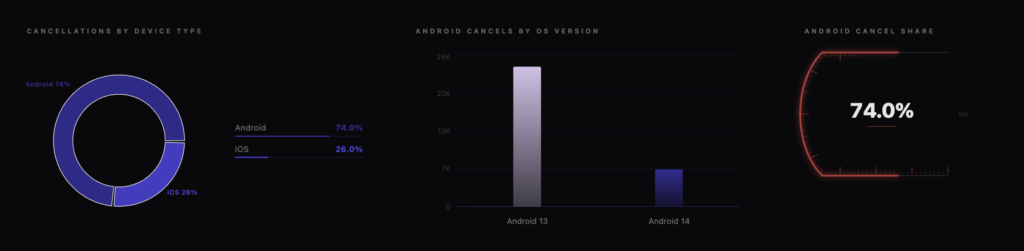
The foundation of the platform provides unified visibility into what is happening in tournaments right now. This real-time tournament visibility includes the live tournament state across all active competitions, player entry rates, match progression, and completion trends, alongside prize pool dynamics, payout tracking, technical performance and player experience metrics. It also includes fraud indicators and anomaly detection to help stay ahead of bad actors.
Near-term predictive intelligence provides further insights, including tournament fill rate predictions (will this tournament reach capacity?); player churn signals (who’s about to abandon mid-tournament?); monetization opportunity identification (where to optimize entry fees or incentives?); developer performance forecasting (which games are trending up/down?); and fraud pattern recognition (emerging abuse tactics before they scale).
Capability 2: Real-Time Player Tiers
Dynamic player segmentation updates as behavior changes. This includes skill-based tiering that adapts to performance, spending pattern classification for monetization targeting, engagement level scoring for retention interventions, fraud risk assessment for proactive prevention, and lifetime value prediction for investment prioritization.
Operational Activation includes matchmaking optimization based on real-time tiers, dynamic incentive targeting to highest-value segments, proactive retention offers to at-risk players, fraud prevention triggers for suspicious tier movements, and personalized tournament recommendations.
Capability 3: Developer Reward Intelligence Hub
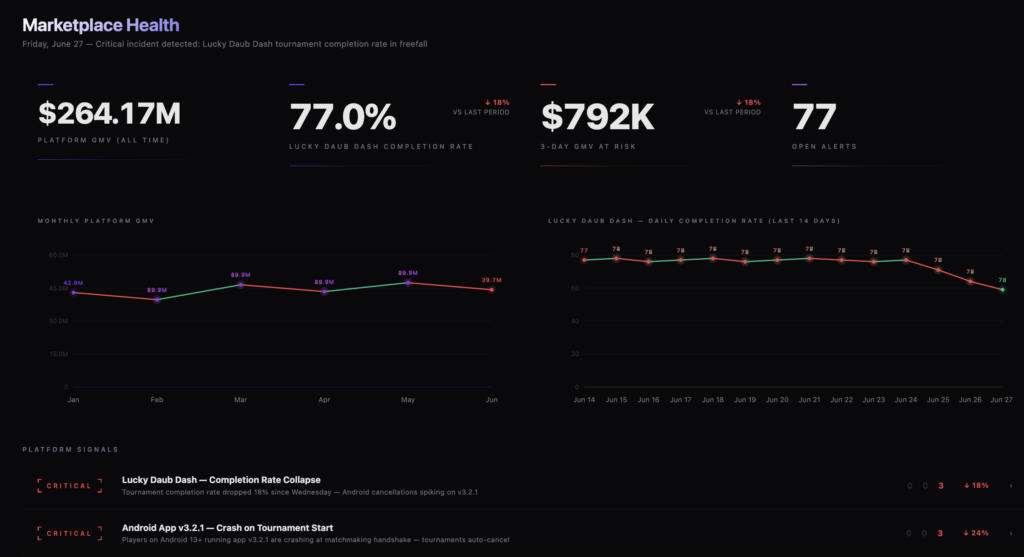
Transparent, real-time performance visibility is also provided for game developers. Live developer dashboards provide insight into tournament performance metrics as games are played, player engagement and retention by game title, revenue generation and payout economics in real-time, comparative benchmarking against other developers, and predictive rewards forecasting based on current trajectory.
Strategic Developer Enablement, meanwhile, offers immediate feedback loop for game iteration, transparent reward calculation and attribution, performance-based optimization recommendations, competitive intelligence for positioning, and long-term growth trend visibility.
How: Building Real-Time Tournament Intelligence
The Implementation: We follow a rapid, four-week validation-to pilot approach that delivers measurable value quickly.
Week 1: Validation Workshop
In our first week, we establish the foundation and validate the approach.
We start with Discovery and Scoping, which includes assessing current batch reporting capabilities and gaps, identifying the highest-impact real-time use cases, mapping tournament data sources and streaming architecture, defining success metrics and baseline performance, and validating technical feasibility and integration points.
During the first week, we also focus on Stakeholder Alignment. We work with operations teams to define real-time monitoring requirements and meet with product teams to identify optimization opportunities. We also huddle with engineering teams to confirm data streaming capabilities, align with executive sponsors on business impact expectations, and work with developers to understand reward transparency needs.
Weeks 2 to 3: Rapid Development and Integration
With discovery wrapped-up, evolv then begins to build the real-time intelligence platform. This includes the Data Integration Layer, including the ability to stream tournament events in real-time (think: match start/end, player actions, transactions). We also integrate player behavioral data and historical patterns, connect fraud detection signals and anomaly indicators, unify developer performance metrics across games, and establish data governance and quality controls.
We also build out the Intelligence Processing Layer, which offers real- time tournament state aggregation and visualization, predictive model deployment for fill rates, churn, and fraud, dynamic player tier calculation and segmentation, developer reward calculation with transparent attribution, and alert generation for intervention-worthy events
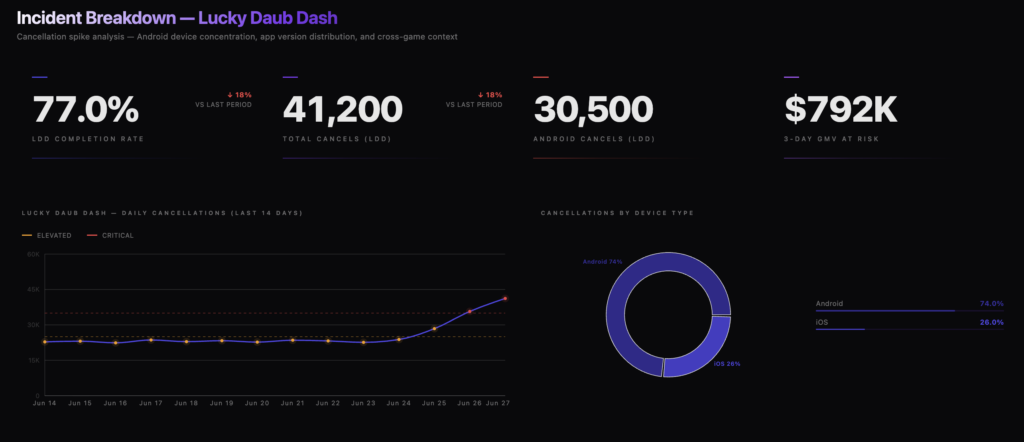
Finally, there’s the Operational Dashboard Layer. This includes the tournament operations cockpit for live monitoring, player tier management interface for targeting and interventions, developer performance dashboard with real-time metrics, executive summary views showing platform health, and mobile-accessible interfaces for on-call response.
Week 4: Pilot Launch and Validation
In the final week, our team deploys to production and measures impact.
Pilot Deployment includes the launch with subset of tournaments or game titles, enables real-time monitoring and intervention capabilities, activates dynamic player tiering and targeting, provides developer partners with live performance visibility, and establishes feedback loops for rapid iteration.
Meanwhile, Impact Measurement includes the ability to compare batch vs. real-time detection speeds, measure intervention effectiveness, including fraud prevention and churn reduction, track monetization optimization result, assess developer satisfaction and engagement, and document operational efficiency gains.
The final piece is Scale Planning, which identifies lessons learned and optimization opportunities. It also identifies lessons learned and optimization opportunities, designs enterprise rollout approach across all tournaments, establish operational playbooks for intervention scenarios, defines continuous improvement processes, and creates training materials for expanded team adoption.
The Three Capabilities Close the Gap – Sequentially
Why This Order Matters:
Step 1 enables Step 2: You can’t dynamically tier players without real-time tournament visibility. Tournament Marketplace Operations Intelligence provides the behavioral data stream that powers real-time player segmentation.
Step 2 enables Step 3: You can’t provide meaningful developer insights without understanding player engagement patterns. Real-Time Player Tiers reveal which games attract high-value, engaged players versus casual participants.
Step 3 completes the loop: Developer Reward Intelligence closes the feedback loop, enabling game creators to optimize for platform success. Better games drive better tournaments, creating a virtuous cycle.
The Impact: Measurable Operational Excellence
These transformations deliver quantifiable improvements across tournament operations:
✓ +12% Tournament Performance Improvement
- Higher fill rates through predictive capacity management
- Better player retention through real-time intervention
- Optimized prize pools based on live demand signals
- Reduced fraud losses through immediate detection
✓ +10% Monetization Efficiency
- Dynamic pricing optimization during tournament lifecycle
- Targeted incentives to high-value player segments
- Reduced customer acquisition costs through better retention
- Improved lifetime value through personalized engagement
✓ 2× Operational Capability
- Manage twice as many concurrent tournaments with same team
- Respond to issues in minutes instead of hours/days
- Scale developer partnerships without proportional overhead
- Handle fraud and abuse before it spreads
✓ Real-Time vs. Batch: The Advantage
- Fraud Detection: Minutes vs. hours – stopping bad actors before damage scales
- Player Intervention: During tournament vs. after exit – saving relationships while recoverable
- Monetization Optimization: Active adjustment vs. next-cycle changes – capturing in-flight opportunities
- Developer Feedback: Live metrics vs. post-mortem reports – enabling rapid iteration
You’re Closer Than You Think
Many tournament platforms assume real-time operations intelligence requires complete infrastructure overhauls. In reality, the path from batch to real-time is shorter than expected:
What You Already Have:
- Tournament event streams (even if not currently analyzed in real-time)
- Player behavioral data (even if scattered across systems)
- Developer performance metrics (even if manually compiled)
- Operational playbooks (even if executed reactively)
What We Add:
- Real-time streaming architecture that processes events as they happen
- Predictive models that turn current state into forward-looking intelligence
- Operational dashboards that surface actionable insights at point-of-decision
- Transparent attribution that builds trust with developers and partners
The four-week path: From validation workshop to live pilot in one month. No rip and replace, no multi-year transformation programs – just focused delivery of high impact capabilities that prove value immediately.
The Bigger Picture
This approach represents a fundamental transformation in tournament gaming operations by moving from reactive batch analysis to proactive real-time control.
Real-Time Tournament Operations Intelligence doesn’t just speed up reporting, it changes what’s possible.
Operations teams shift from post-mortem analysis to active intervention. Product teams shift from A/B testing cycles to dynamic optimization. Developer partners shift from opaque reward systems to transparent performance visibility. And players experience seamless tournaments that adapt to demand, prevent abuse, and deliver consistent quality.
In a commoditized mobile gaming market, operational excellence becomes the differentiator. Platforms that master tournament intelligence create advantages that pure game mechanics can’t replicate.
Ready to close the gap from batch to real-time? Check out our service catalog offering, and then let’s talk about how evolv can help you transform tournament operations from reactive reporting to proactive intelligence – in four weeks.

Mike Henry is a consulting leader at evolv who helps organizations turn data and AI initiatives into practical business outcomes. He leads the firm’s Diversified Portfolio, partnering with companies across industries to identify opportunities where modern data platforms and AI can accelerate growth, reduce complexity, and improve decision-making.
Prior to evolv, Mike spent more than fifteen years leading large consulting engagements at Accenture and Valtech, managing various accounts and cross-functional teams delivering complex digital and cloud initiatives. Based in Colorado, Mike enjoys spending time outdoors with family, friends, and his two dogs when he’s not working with clients.