

by Tobi Hathorn and Jeremy Newhouse
Across industries, the story is frustratingly familiar: an AI pilot earns executive enthusiasm — and then quietly stalls. Months pass. The proof of concept never makes it to production. The investment sits idle, and the organization is left asking why AI keeps promising more than it delivers.
The root cause is rarely the actual technology. Instead, it’s the missing operating model around AI — the governance, architecture standards, and strategic alignment needed to carry a promising experiment into enterprise reality.
That is the gap evolv is built to close.
The Problem: AI Investments Stall Before They Scale
Most organizations have no shortage of AI ambition. But pilots are often built in isolation, without the infrastructure, governance, or organizational readiness needed to fit in with the broader enterprise. The result? A graveyard of technically sound experiments that never delivered business value.
The warning signs tend to cluster in predictable ways:
- Limited executive visibility into what’s working: There’s no common language between what the technical team built and what leadership needs to justify continued investment.
- ROI is hard to prove consistently: Without clear outcome mapping, it’s difficult to connect AI activity to measurable business impact.
- Architecture fragments across teams: Without standardized standards, connecting AI outputs to existing workflows becomes its own project.
- Security and compliance show up too late: Governance gets added on post-hoc, creating risk and slowing deployment.
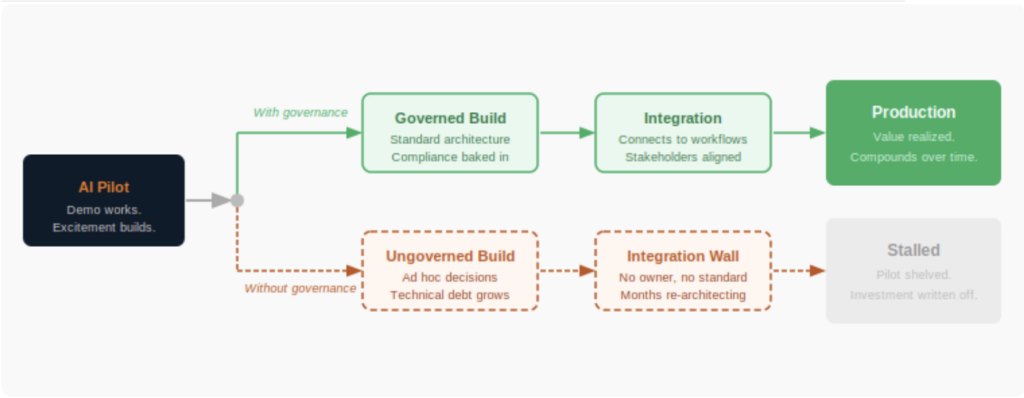
Most AI pilots don’t fail because the technology doesn’t work. They fail because no one built the path from proof-of-concept to production.
The organizations getting AI right aren’t just moving faster, they’re compounding advantages. Every quarter spent in pilot purgatory is a quarter that competitors are translating AI into reduced costs, better customer experiences, and faster decision-making. For regulated industries in particular, the stakes are especially high. Without explainable, auditable AI, regulatory exposure alone can outweigh any efficiency gain.
What: A Governance-First Framework for Enterprise AI
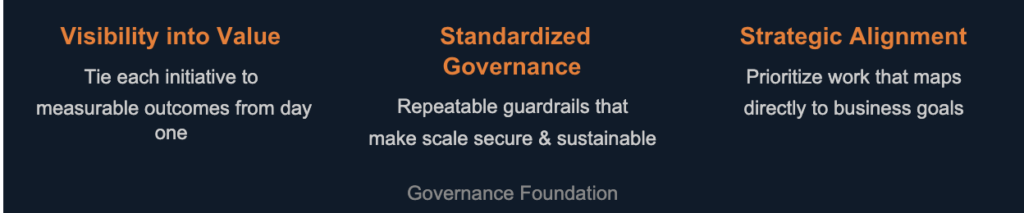
evolv designs and delivers AI transformation engagements that treat governance not as a final step, but as the foundation everything else is built on. Our approach is built around the three things that consistently move organizations from pilot activity to repeatable, production-ready delivery: visibility into value, standardized governance, and strategic alignment.
Why These Three Things?
Most AI programs have plenty of activity — pilots running, models trained, demos delivered. What they lack is a clear line between that activity and business outcomes. Without visibility into value, ROI stays hard to prove. Without standardized governance, scale stays out of reach. And without strategic alignment, effort gets poured into the work that’s technically interesting rather than the work that maps to what the business actually needs. evolv’s engagements are structured to close all three gaps at once.
How: A Structured Path from Idea to Impact
evolv’s AI engagement model is designed to move fast without cutting corners. As part of our AI Value Realization framework, we deliver a working pilot that demonstrates tangible business value — and a clear path forward — in weeks, not the months or years a traditional program would demand.
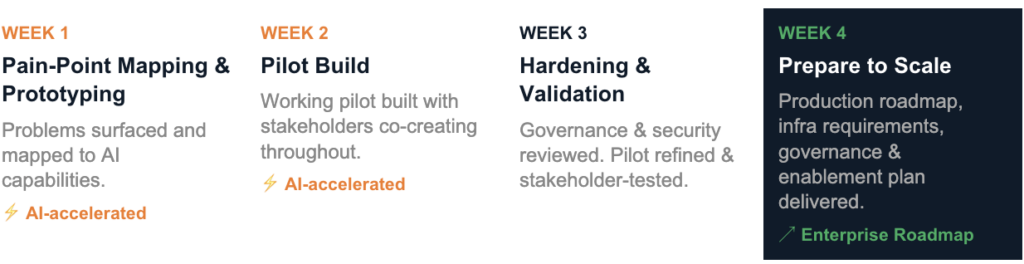
Week 1: Pain-Point Mapping & Prototyping: We begin by identifying the specific pain points where AI can deliver the highest-value outcomes, then map them to proven capabilities and assess feasibility fast. evolv’s proprietary AI-powered accelerators handle the heavy analytical lifting, freeing our consultants to spend their time listening to your team, understanding the nuance behind the data, and ensuring the problem we’re solving is the right one. That speed isn’t incidental; it reflects how we operate. AI isn’t something evolv consults on from the outside — it’s embedded in our own work.
Week 2: Pilot Build: With the problem defined, we move into rapid prototyping. Our AI-native tooling compresses what typically takes weeks of manual build work into days, but the real benefit is what that buys back for the people in the room. Rather than waiting on outputs, your business stakeholders are part of the conversation throughout by shaping assumptions, pressure-testing ideas, and validating that what we’re building reflects how your organization actually works.
Week 3: Hardening and Validation: With a working pilot in hand, we shift focus to making it more robust. Governance and security considerations are reviewed, key scenarios are tested, and the solution is refined based on stakeholder feedback. The goal is a pilot that’s credible and ready to be evaluated, not just in a demo but as a genuine business tool.
Week 4: Prepare to Scale: At the close of the engagement, organizations receive a clear, detailed roadmap covering production deployment, infrastructure requirements, governance frameworks, and organization-wide enablement. Leadership walks away with the visibility and confidence to make strategic resource decisions — and a concrete plan to execute them.
The Impact: Why Organizations Choose evolv
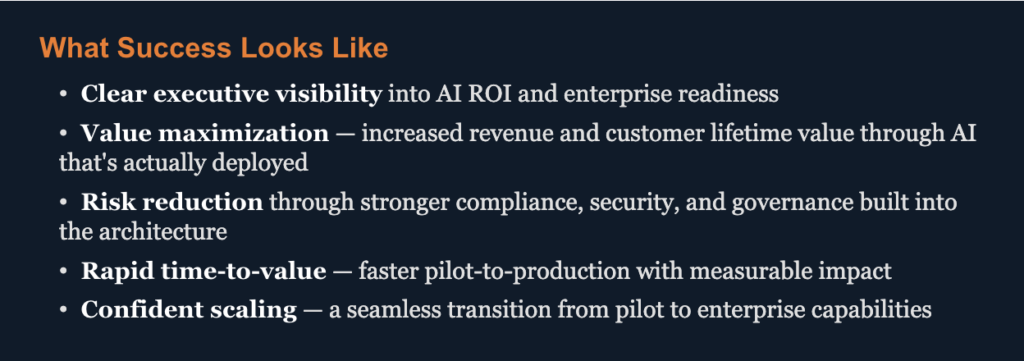
The difference between an AI pilot that scales and one that stalls often comes down to who built it and how. evolv brings a combination of capabilities that most consulting engagements don’t:
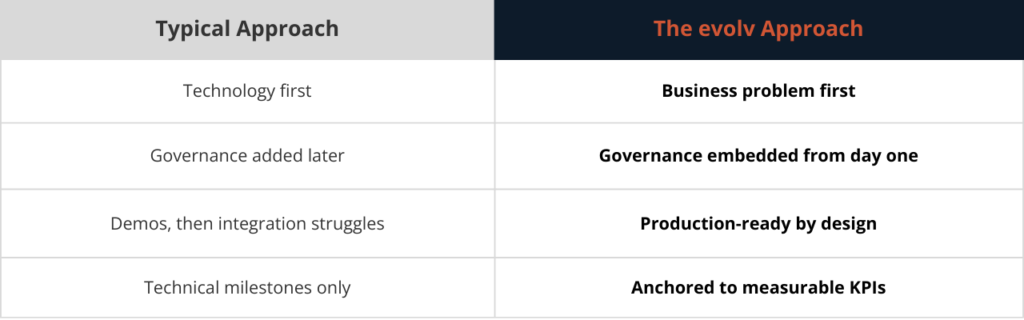
The goal isn’t a better pilot — it’s repeatable, production-ready delivery with a clear path to enterprise scale. That means walking away with a governance framework, a production roadmap, and the organizational confidence to treat AI as a strategic investment rather than a series of isolated experiments.
Ready to turn AI ambition into demonstrated business value? Let’s talk about where to start.



Tobi Hathorn is a Solution Delivery Principal and co-leader of Product AI Service Line at evolv with over a decade of experience helping organizations innovate and deliver meaningful business outcomes through emerging technology. He specializes in applying AI capabilities to real-world enterprise challenges, guiding clients on how to implement and adopt AI-driven solutions at scale. In a recent engagement, Tobi helped a client build a retrieval-augmented generation (RAG) conversational agent to surface real-time insights for consumers while significantly reducing call center demand. Known for bridging technology and strategy, Tobi partners with teams to turn complex technologies into practical, high-impact solutions while emphasizing thoughtful, responsible use of AI.
Jeremy Newhouse is the Head of AI at evolv Consulting, where he leads the firm’s end-to-end AI capability—from strategy and solution architecture to hands-on AI engineering and delivery execution. Jeremy is especially strong in building modern AI systems in the real world, including AI platforms, GenAI/LLM applications, agentic workflows (multi-agent systems), and innovation accelerators that help clients move from experimentation to production outcomes faster. Based in the Dallas–Fort Worth area, he’s known for pairing executive-level advisory with a builder’s mindset—creating repeatable delivery patterns, prototypes, and go-to-market assets that elevate quality and speed across engagements. Previously, Jeremy was Head of Data & Analytics Products at Cognizant, leading global teams and data products that delivered measurable value through major performance improvements, meaningful efficiency gains, and risk reduction across enterprise analytics initiatives. He’s also a founder: as CEO and Founder of Salient Data, he launched AI-first platforms and agentic process automation solutions, bringing entrepreneurial product thinking and innovation leadership into his consulting practice. Jeremy holds an educational foundation in Software Engineering, has completed extensive graduate-level work and executive training in Data & Analytics and AI, and is a named inventor on a patent in large-scale risk analytics.