
By Camilo Gomez
Most enterprise reporting arrives late. You ask for a report, wait a week, and read what happened… after the decision it should have informed is already made.
Snowflake Summit 2026 centered on a fix for that lag: the agentic enterprise. Snowflake’s leaders described a move from using data to report the news to using it to drive action as it happens. The question shifts from “can we analyze this?” to “shall we act on this?”
For a Snowflake Elite partner like evolv, the shift matters less as a product launch and more as a change in how companies set strategy and respond to pressure. Below are the moments from the keynote stage that count, and what they mean for how organizations decide.
The shift from reactive reporting to proactive action
In the old model, analysts sit at the end of a queue. One person asks a question, another builds the report, and leaders read it after the fact. Agentic systems reverse that order. The agents flag shifts, surface risks, and propose responses before a problem grows, without waiting to be asked.
The change shows up in three places.
- Anticipating disruption: Rather than explaining a supply chain failure after deliveries slip, agents watch supply, demand, and production signals and flag the shift while planners still have room to respond.
- Acting on early signals: Instead of analyzing customer loss after revenue drops, the system catches churn signals early and prompts the account team to reach out while the relationship holds.
- Reallocating fast: Budget shifts and inventory moves that once took a chain of meetings and manual hand-offs happen in hours, because the agent reads market signals and acts on them.
The common thread is timing. These systems close the gap between question and action, the gap where companies lose most of the value in their data.
Snowflake CoCo, Snowflake CoWork, and the agentic control plane
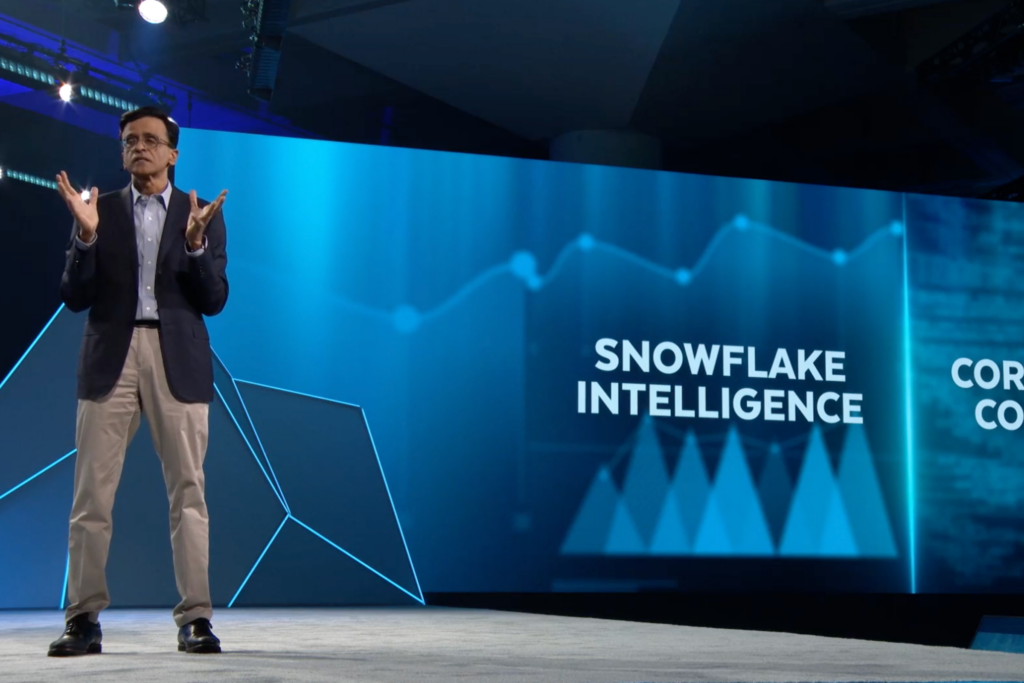
Snowflake backed the vision with product news. Cortex Code is now Snowflake CoCo, and Snowflake Intelligence is now Snowflake CoWork. Both act as control planes that let people manage data in plain language instead of routing every request through a specialist.
Two pieces matter most for decisions at scale:
- Cortex Sense, a runtime capability, gathers context from a company’s data and user activity so agents reason over the whole business instead of a narrow slice. In Snowflake’s evaluations, that added context raised the accuracy of an agent’s suggestions from 24 percent to 83 percent. The gain came from feeding the agent more context, not from a larger model.
- Snowflake CoWork also provides an agentic control plane. As agents spread across finance, supply chain, and marketing, a new risk appears: a sound decision in finance can contradict a sound decision in operations. The control plane works as mission control, keeping the agents coordinated so the company runs one strategy instead of several that fight each other.
What this changes about strategy
When an agent pulls a forecast, flags a risk, and drafts the prep work without being asked twice, planning conversations change.
Leaders stop spending cycles reconstructing last quarter and start spending them on the next move. Because agents tie suggestions to specific outcomes, the work maps to P&L lines like revenue, cost of goods sold, and SG&A, not to dashboards that someone still has to translate into a decision.
It also spreads expertise. With intelligence built into the daily workflow, a salesperson opens a pre-call plan that flags which accounts need attention, and a planner sees a demand shift the moment it registers. Work that used to wait on a data scientist now sits in the tools people already use.
What this changes about adaptability
Adaptability comes down to one number: how fast a company can pivot once it sees something change. The agentic model works on that number from two directions.
The first is speed: Tasks that ran on a weekly or monthly cadence drop to near real time. Snowflake pointed to data engineering, where migrations that once took six months finished in about six days. The bigger effect lands a step later. When routine engineering stops eating the team’s hours, that talent moves to work the company could never staff before.
The second is coordination: Speed backfires when teams pull in different directions. The control plane holds speed and alignment together, so the business moves fast without splintering into local decisions that conflict.
Both gains compound through learning. Agents pick up how a role works and what a person needs, so the system grows more useful to each user over time instead of resetting to a generic default on every query.
Governance you can defend
None of this works if leaders cannot trust the output. Snowflake spent stage time on Horizon, its catalog for unified governance and security, showing how agents can act on enterprise data inside consistent controls. This is the harder half of the agentic enterprise.
Regulated industries face a higher bar. A decision an agent makes or informs has to meet what Snowflake called a fiduciary-grade standard: governed, transparent, and validated enough that a lawyer, accountant, or risk officer can stand behind it. Without that footing, speed turns into exposure. Strong governance is what lets a company use these agents at full tilt.
How evolv helps
Most organizations leave Summit with the same two questions:
- Where will this pay off for us?
- How do we adopt it without taking on risk we cannot see?
evolv’s AI Value Realization framework answers both, and it does it in four weeks.
On the first question, we start with the decisions that run your business. In the opening week we map your highest-value pain points, the recurring calls in supply, finance, service, or sales where acting earlier changes the result, and test which ones an agent can take on. Our AI accelerators handle the analytical lifting, so our consultants spend their time learning your data and the problem behind it. You finish with a working pilot tied to a measurable outcome.
On the second question, governance is the foundation we build on from day one. We bring your business stakeholders into the build so the pilot reflects how your organization works, then harden it with a security and governance review, tests on the scenarios that count, and refinement on your feedback. Leadership leaves with a production roadmap that covers deployment, infrastructure, governance frameworks, and organization-wide enablement, and the visibility to fund the next step with confidence.
You walk away with repeatable, production-ready delivery and a clear path to enterprise scale. We run AI inside our own delivery, which is how a four-week pilot stays four weeks.
Let’s work together
The agentic enterprise changes the tense of the work. For years, reports told companies what had happened. The approach Snowflake laid out at Summit 2026 moves the work into the present and near future, where the decision is still open and a faster, coordinated response still counts.
Companies that make the shift move with their market instead of reading about it after the fact.
Ready to turn the agentic enterprise into decisions your team can act on? Connect with evolv.

Camilo Gomez is evolv Consulting’s LATAM general manager, overseeing the organization’s office in Colombia and building the nearshore team that ships software and consulting services for global clients. With over 20 years of experience in the technology sector, Gomez brings a proven track record in operational leadership, digital transformation, and application modernization. He has successfully led cross-functional teams, secured multi-million-dollar deals with Fortune 500 companies and startups, and mentored emerging ventures through Endeavor, The Founder Institute, and Startup Weekend.