by Daniel Phillips Sánchez
I left Claude running a task and went to feed my twins. By the time I’d washed them, read a short book, and helped my wife get them down, the task was finished. The same orchestration logic I build for financial institutions ran quietly in the background on a Tuesday night.
***
When I started on agentic orchestration for financial risk, I assumed the hard part would be the models, the data pipelines, the ML architecture. The real problem was that the departments weren’t sharing information in real time.
Risk, marketing, and sales each had data the others needed. There was no shared layer that made real-time exchange possible, so each department operated on a different picture of the same customer.
For example, the sales team would run a campaign targeting a high-value segment. Meanwhile, the risk team already flagged several customers in that segment as elevated exposure. But neither team knew what the other one was doing. The campaign ran, the customers converted, and the exposure materialized. The institution spent resources acquiring customers who were already on their way to becoming losses. The failure was in the coordination, not the detection.
What We Built, and What Moved
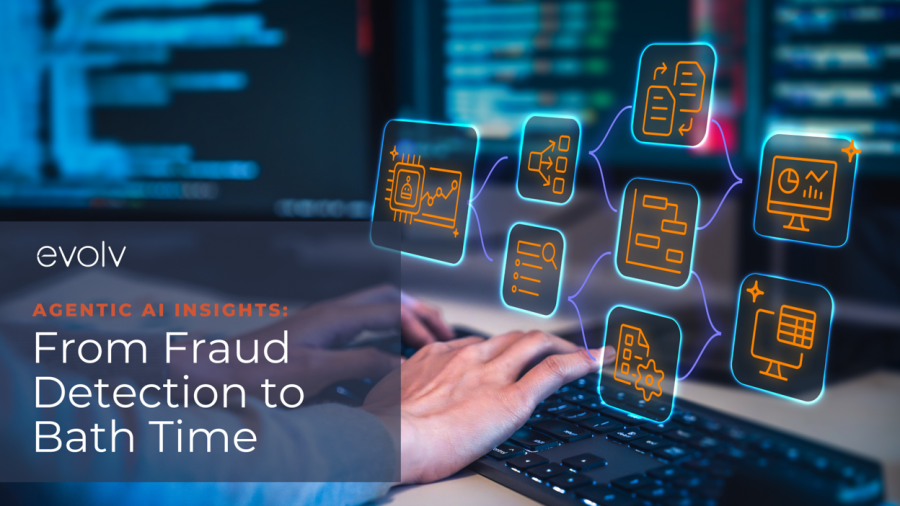
To increase coordination, we built an orchestration layer using ML and Claude as the intelligence connecting department outputs. Risk signals, sales activity, and marketing behavior feed into a single shared view. Each team acts on the same picture, and the model learns from the full signal.
What mattered more than aggregate detection rates was the category of risk the model began surfacing on its own: behavioral signals that span all three departments, patterns no individual team had thought to define because no single team could see them. Fraud had been invited in through the front door because the departments greeting customers had no visibility into what the risk team knew.
Teams now get feedback that allows them to adjust their selling strategy and identify when a customer is moving toward a risk state before it becomes a loss. The model gets sharper because the training signal finally spans all three departments.
Where this lands: A financial institution with this cross-department layer stops generating some of the risk it used to spend money detecting.

Running the Same Architecture at Home
My wife and I have fraternal twins. Family life has the same problem at a smaller scale: a pile of tasks that need to get done but don’t need you doing them.
Managing family finances used to take two to three hours a month. Multiple accounts, manual data gathering, analysis, then walking my wife through what changed so we could make decisions together. Now, with a set of skills I built in Claude (connected via MCP to our Google accounts), the gathering and initial analysis run automatically. We spend under 15 minutes on the decisions themselves.
At work, the outcome is measured in fraud caught. At home, it’s measured in bath time.
What This Requires
Neither version runs itself. A financial institution’s orchestration layer requires integration work, change management, and monitoring as the model learns. The detection gains grow as departments share more and the model sees more, but that takes all three teams willing to share their data and act on a shared view.
At home, I check in. When a task ran longer than expected, I looked at it between bath and bedtime, confirmed it was on track, and kept going. Supervision is not the same as attention — but it’s not nothing.
The skill is knowing what to put in the background. Over-supervise and you’ve saved nothing. Under-supervise and you miss a failure before it matters.
What It Makes Possible?
The better question may be what agentic AI makes possible, not what it replaces.
For a financial institution, that means a shared intelligence layer that surfaces patterns no single department was positioned to see.
For me on a Tuesday, it meant bath time with my twins.
Working With evolv
The team at evolv builds agentic orchestration systems that connect departments that were operating independently and turn the shared view into better decisions. The financial services work is one example: cross-department intelligence that improves risk detection, sharpens selling strategy, and gets more accurate over time.
If your risk and sales teams are working from different pictures of the same customer, that gap is where the losses come from. Reach out and let’s close it.
Reach out and let’s build something real.

Daniel Phillips Sánchez is an AI & Data Scientist with experience designing and delivering machine learning, data engineering, data science and AI solutions for enterprise environments. Skilled in Python, SQL, Snowflake, and large language models, with a track record of building scalable data platforms and production-ready applications. Comfortable leading technical initiatives, collaborating with cross-functional teams, and translating business needs into practical solutions that improve decision-making and operational efficiency.