
In wealth management and financial services, compliance is the foundation of trust and regulatory standing. But many of the compliance teams we work with – particularly those firms managing hybrid advisor models under SEC and FINRA oversight – often find themselves drowning in alerts while still missing critical risks.
Manual, reactive review processes driven by high volumes of low-quality alerts create operational friction, slow remediation timelines, and increase costs. Meanwhile, fragmented data across trade activity, advisor communications, and case management systems limits visibility and makes it nearly impossible to assess risk holistically.
The result: Prolonged investigations, increased risk of missed violations, and reduced defensibility during regulatory exams. Here’s how evolv is helping financial services organizations transform compliance from volume-based monitoring to intelligent, risk-based oversight.
A quick note before we dive in: A video embedded in this post provides a quick look at how evolv leverages Snowflake Cortex Code to spin up business outcomes quickly for our clients. We can deliver a true demonstration of tailored solutions just like this to solve your business problems. If you like what you see, reach out!
Why: The Compliance Paradox – More Alerts, Less Insight
Compliance teams operate under heightened regulatory scrutiny, yet their monitoring infrastructure works against them:
- Manual, Reactive Review Processes: Teams chasing alerts instead of prioritizing risk;
- High Volumes of Low-Quality Alerts: False positives overwhelming reviewers and burying real issues;
- Fragmented Data Sources: Trade activity, advisor communications, and case records scattered across disconnected systems;
- Limited Holistic Visibility: No unified view to assess risk across multiple dimensions;
- Weak Audit Traceability: Incomplete documentation that undermines regulatory defensibility.
These gaps aren’t just operational inefficiencies – they’re direct threats to regulatory standing and business viability. Real issues are often buried under false positives, increasing the risk of missed violations. Reviewers spend hours gathering context from multiple systems, dragging out investigations. Growing alert volumes increases the number of people needed to manage them, leading to higher operational costs. Incomplete audit trails fail scrutiny during SEC or FINRA exams, reducing regulatory defensibility. And all of this leads to a competitive disadvantage for these companies, especially compared to firms with intelligent compliance monitoring already in place.
The business imperative is clear: scale compliance oversight, reduce false positives, and strengthen audit readiness – without increasing operational cost.
What: Intelligent Compliance Monitoring Through Risk-Based Prioritization
evolv designs Intelligent Compliance Monitoring platforms that shift compliance from reactive review to risk-based prioritization. Rather than adding more alerts, we focus on improving signal quality and reviewer efficiency by unifying compliance data and embedding explainable risk scoring into workflows.
Our approach centers on four core capabilities:
- Unified Compliance Data Foundation: We consolidate fragmented compliance data into a single governed view, trading activity across all channels and products. This includes everything from advisor communications (think: email, messaging, and recorded calls) to case management records and resolution history. It also incorporates advisor metadata and supervisory structures alongside historical exception patterns and outcomes.
- Explainable Risk Scoring: We implement intelligent algorithms that prioritize the highest risk activity. Risk-based alert prioritization scores alerts by likelihood of a true violation, not just rule triggers. Pattern recognition identifies behavioral anomalies and emerging risk patterns, and multi-dimensional risk assessment evaluates activity across trade patterns, communication sentiment, and historical behavior. And every score comes with clear, auditable reasoning.
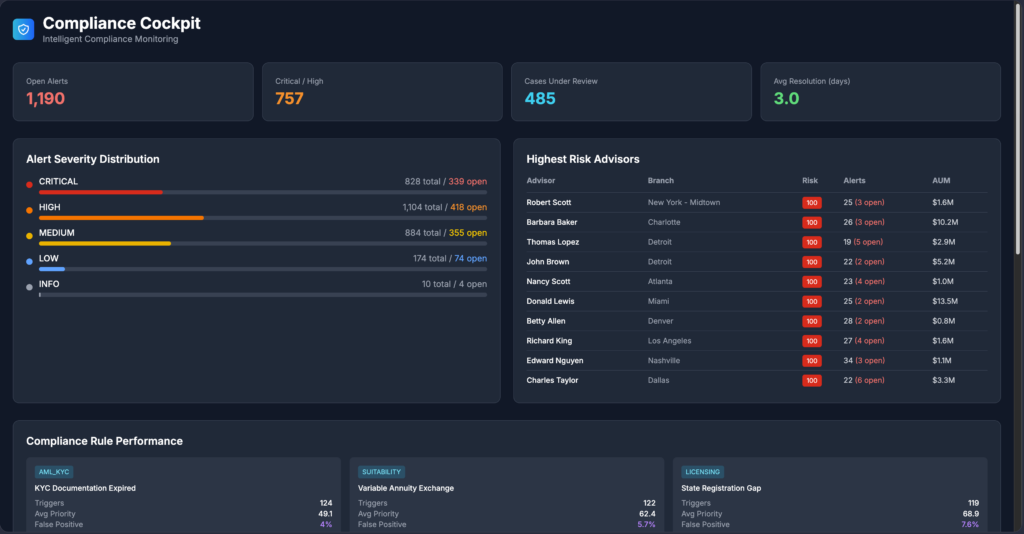
- Centralized Reviewer Experience: We design a compliance “cockpit” that streamlines investigation and resolution, including prioritized alert queues ranked by risk score and contextual case views that combine trade data, communications, and advisor history. One-click investigation workflows offer embedded context, and collaborative case management includes team-based reviews.
- Complete Audit Traceability: We preserve end-to-end audit trails for regulatory defensibility, capturing every action, decision, and any supporting evidence. We document risk-scoring logic and alert prioritization rationale, maintain immutable records for regulatory exams, and enable audit-ready reporting on compliance effectiveness.
How: Delivering Risk-Based Compliance Intelligence
evolv builds Intelligent Compliance Monitoring platforms that integrate multiple data sources into a unified compliance experience.
We create a comprehensive compliance data model that includes trade activity data like transactions, order flows, execution details, trade patterns, and timing anormalities alongside communications data like advisor emails, messaging platforms, recorded calls and sentiment analysis. Our data model also includes case management data such as historical exceptions, resolution types, remediation actions, and recurrence patterns as well as advisor metadata like registration status, disciplinary history, supervisory relationships, and product authorizations. Regulatory rule sets for SEC, FINRA, and firm-specific policies are embedded as enforceable logic.
Via our risk scoring and prioritization engine, we deploy intelligent algorithms that improve signal quality. Risk scoring models evaluate alerts across multiple risk dimensions, including trade pattern anomalies, communication flags, and historical behavior – along with generating explainable risk scores and adapting scoring models based on resolution outcomes and emerging patterns. Alert prioritization logic ranks alerts by risk score, potential impact and urgency, surfacing highest-risk activity for quick review and suppressing low-quality alerts that historically yield false positives. Pattern Recognition identifies emerging risk patterns across advisors and teams, detects behavioral changes that signal potential compliance drift, and correlates trade activity with communication context for holistic assessment.
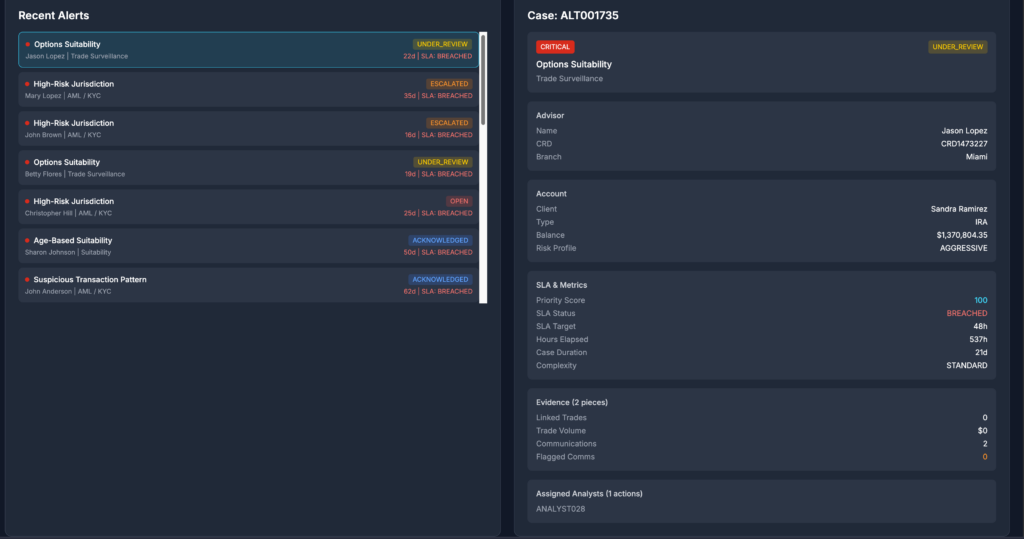
Our Centralized Reviewer Cockpit is a unified interface that transforms how compliance teams work. A prioritized alert queue ranks alerts by risk score, with clear prioritization, while filtering and segmentation by risk tier, advisor, product, or exception type – and updates in real-time as new alerts arrive or cases are resolved. The cockpit’s single view combines trade activity, communications and advisor metadata alongside an embedded timeline showing sequence of events, quick access to related cases and historical patterns, and collaboration tools for team-based investigations, enabling contextual case management.
Investigation workflows offer one-click access to supporting evidence and context, guided workflows for common exception types, escalation paths with clear approval chains, and automated documentation capture for audit trails.
We also ensure complete defensibility via Audit Trail and Regulatory Reporting such as immutable audit trails that capture every reviewer action: view, investigate, approve, escalate, dismiss. Decision rationale and supporting evidence is documented, risk scoring logic and alert prioritization methodology is preserved, and the complete lineage from alert generation to case resolution is maintained. These platforms also include pre-built reports for SEC and FINRA exam readiness, compliance effectiveness metrics (review cycle times, false positive rates, remediation speed), exception trend analysis and emerging risk identification, and customizable dashboards for supervisory oversight.
The Impact: Measurable Compliance Effectiveness
These transformations deliver quantifiable improvements across compliance operations, including via key metrics such as a reduction in review cycle time, a decrease in exemption volume, faster remediation speed, and improved regulatory exam outcomes:
✓ Faster Review Cycles: Risk-based prioritization reduces time spent on low-risk activity and allows reviewers to focus their work where it will make the most impact.
✓ Reduced False Positives: Improved signal quality lowers the unnecessary review volume, and intelligent scoring suppresses low-quality alerts.
✓ Stronger Audit Defensibility: Complete, explainable audit trails improve regulatory readiness and transparent risk scoring satisfies SEC and FINRA exam requirements.
✓ Lower Compliance Costs: Increased reviewer efficiency enables scale without added headcount and automation of routine tasks frees capacity for complex investigations.
✓ Improved Regulatory Confidence: Holistic risk assessment demonstrates proactive oversight and documented effectiveness metrics strengthen exam outcomes.
The Bigger Picture
This approach represents a fundamental shift in compliance operations, from volume-based monitoring to risk-based prioritization. By unifying fragmented data, deploying explainable risk intelligence, and streamlining reviewer workflows, financial services organizations can scale compliance oversight while reducing operational burden.
Intelligent Compliance Monitoring platforms don’t just process more alerts — they transform compliance effectiveness. Reviewers shift from chasing volume to managing risk. Supervisors shift from reactive oversight to proactive prevention. Executives shift from cost-center thinking to strategic compliance advantages. And regulators see firms that demonstrate proactive, effective oversight through transparent, auditable processes. You can also check out our Service Catalog Offering to find out more about the specific solutions capabilities to support you on your journey.
Ready to transform compliance from alert fatigue to intelligent oversight? Let’s talk about how evolv can help you build risk-based compliance monitoring that scales effectiveness while reducing costs.

Katie Hocking is a Director of Client Engagement at evolv Consulting, partnering with enterprise and financial services leaders to drive data and AI transformation, and measurable business outcomes. She brings over 15 years of experience working in highly regulated industries, including healthcare and financial services, where she has helped organizations navigate complexity, change, and growth.
Known for building trusted executive relationships, Katie works at the intersection of strategy, experience, and delivery by aligning client goals with data driven solutions. She brings a relationship‑first mindset to every engagement, connecting vision to execution and fostering long‑term partnerships that create value for both clients and their customers.