
In high-mix manufacturing environments – electrical components, aerospace systems, industrial equipment – unplanned downtime is a direct hit to earnings, service levels, and competitive position.
For the manufacturing clients we work with in high asset-intensity environments, the challenge is clear: overall equipment effectiveness (OEE) variance, cycle time unpredictability, and downtime variability materially impact margin and backlog conversion. Meanwhile, demand is accelerating due to electrification and grid modernization, making operational excellence a strategic imperative.
Yet most plants still operate reactively, responding to failures instead of preventing them. Here’s how evolv is helping manufacturers embed predictive intelligence at the operator workstation to reduce unplanned downtime by 10-20% and improve OEE by 5% in just six months.
A quick note before we dive in: A video embedded in this post provides a quick look at how evolv leverages Snowflake Cortex Code to spin up business outcomes quickly for our clients. We can deliver a true demonstration of tailored solutions just like this to solve your business problems. If you like what you see, reach out!
Why: The Hidden Cost of Reactive Maintenance
The Problem: Manufacturing operations suffer from fragmented visibility and reactive responses that erode profitability, and teams across the entire enterprise feel the impact.
For Plant Operations teams, unplanned downtime erodes earnings before interest, taxes, depreciation, and amortization (EBITDA), as every minute of unexpected stoppage translates directly to margin loss. Skilled labor constraints increase exposure, as fewer experienced technicians mean longer resolution times. High product mixes increase complexity, as more stock keeping units (SKUs) and changeovers create more failure modes to manage. And of course, reactive maintenance cycles are bad for business — teams are fighting fires instead of preventing them.
For IT and Data leaders, latency in manufacturing execution systems (MES) and enterprise resource planning (ERP) limits real-time visibility, since critical operational data arrives too late to act on it. Reliability is reduced by fragmented telemetry, as sensor data is often scattered across disconnected systems. Manual logs contribute to the problem — handwritten downtime records can’t be analyzed systematically, after all. And when plants lack unified asset ID, they’re unable to consolidate OEE modeling or compare performance.
For Executive Leadership, demand is accelerating faster than capacity, as electrification and grid modernization are driving an unprecedented backlog. Backlog growth doesn’t translate to profitability without operational control, meaning margin compression happens without visibility. OEE variance reduces predictability, since leaders can’t confidently commit to delivery timelines when plant performance varies wildly. And when leaders don’t know where capacity constraints truly exist, it creates capital investment uncertainty.
Why the Urgency: Without unified asset telemetry, standardized downtime classification, and predictive alerts embedded at the point-of-action, downtime remains reactive instead of proactively mitigated. The result:
- Erosion of EBITDA with every unplanned stoppage
- Service level commitments at risk due to unpredictable throughput
- Competitive disadvantage as others achieve operational excellence
- Inability to capitalize on demand acceleration in high-growth markets
What: Predictive Plant Intelligence Embedded Where Decisions Happen
evolv designs Predictive Downtime and OEE Intelligence platforms that move manufacturers from reactive response to proactive prevention. Rather than building dashboards that sit unused, we embed predictive intelligence directly at the operator workstation and maintenance decision point.
Our approach centers on four core capabilities:
- Unified Asset Telemetry Layer: We consolidate fragmented sensor data and operational systems, including real-time machine telemetry (vibration, temperature, pressure, performance metrics), MES and ERP production data, quality logs and downtime records, maintenance ticket history and resolution patterns, and unified asset identification across plants for comparative analysis.
- OEE Modeling and Downtime Classification: We create standardized frameworks for measuring and understanding performance, including comprehensive OEE calculation (Availability × Performance × Quality across all production lines), standardized downtime classification that creates consistent categorization that enables root cause analysis, failure mode analysis that identifies top contributors to unplanned downtime, and plant-to-plant benchmarking that helps teams understand performance variance and best practices.
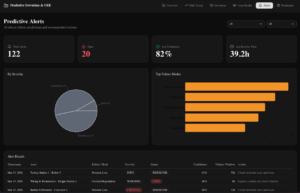
- Predictive Intelligence for Top Failure Modes: We deploy machine learning models that identify issues before they cause downtime, including predictive alerts that generate early warning signals for the top 3 failure modes causing most impact. Anomaly detection identifies equipment behavior that is trending toward failure, while pattern recognition correlates sensor data with historical failure patterns. Meanwhile, explainable AI provides transparent reasoning for every alert, building operator trust.
- Embedded Workflow Integration: Intelligence that stays in dashboards doesn’t prevent downtime, so we embed insights where the action happens, including via real-time operator dashboards with actionable alerts. We also deploy maintenance ticket integration with predictive recommendations, mobile-enabled technician workflows with equipment context, and clear operational-financial linkage showing cost per unit impact.
How: Delivering Predictive Intelligence in Six Months
evolv follows a pilot-first approach that delivers measurable value before scaling.
Phase 1: Pilot Plant Foundation (Months 1-2): We start with a single pilot plant to prove value, and the work begins with data profiling and quality assessment, as we work to understand telemetry quality, identify gaps, and a establish a baseline. Next, we consolidate sensor data, MES, ERP, and maintenance systems to create a Unified Asset Telemetry Layer. We are then able to implement Asset ID Standardization, creating consistent asset identification for tracking and analysis. Finally, we calculate the current OEE and identify top downtime contributors to establish an OEE baseline.
Phase 2: Predictive Intelligence Development (Months 3-4): In the pilot’s next phase, our team helps build and validates predictive models. We implement consistent taxonomy across operators and shifts to create downtime classification standardization. We also analyze historical data to find the highest-impact failure patterns, and build machine-learning models for the top three failure modes to develop predictive alerts. We then work with operators to calibrate alert thresholds and reduce false positives.
Phase 3: Workflow Operationalization (Month 5): As the pilot rolls on, we begin to embed intelligence into daily operations by deploying operator dashboards that provide real-time visibility with predictive alerts at workstations. Alerts automatically generate maintenance tickets with context, providing maintenance workflow integration, and field teams receive alerts with equipment history and recommended actions on mobile devices. Hands-on training ensures that operators feel confident using these tools — and that the tools are ultimately used.
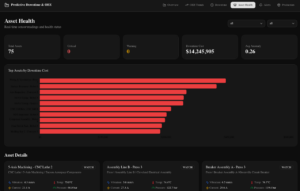
Phase 4: Validation and Scale Planning (Month 6): The final month is all about measuring impact and preparing for expansion. KPIs are tracked as we monitor OEE improvement, downtime reduction, and mean time to repair (MTTR) decrease. ROI validation takes place, as we calculate cost per unit savings and margin improvement. We also document what worked, what didn’t, and how to optimize moving forward — and unveil a multi-plant rollout plan, a scalable deployment approach for enterprise expansion.
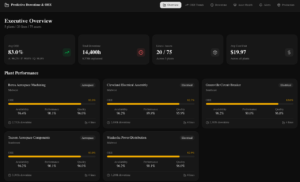
Executive Intelligence Layer: The pilot also gives leadership visibility into operational performance, including via OEE trends by plant, line, and shift; downtime root cause analysis and cost impact; predictive alert effectiveness and operator response rates; and financial impact tracking that reports margin improvement per production line.
The Impact: Measurable Operational and Financial Results
These transformations deliver quantifiable improvements validated through pilot deployment, including:
✓ 10-20% Reduction in Unplanned Downtime: Proactive intervention prevents failures before they impact production, as teams shift from reactive firefighting to predictive maintenance.
✓ 5% OEE Improvement: Early detection of process drift and improvement performance through optimized operating parameters helps keep machines up-and running, preventing downtime.
✓ Reduced Mean Time to Repair (MTTR): Machines get fixed faster when technicians arrive with context and recommended actions, can identify root causes quicker thanks to historical pattern analysis, and be proactive in fixing parts by monitoring predicted failures.
✓ Real-Time Operator Dashboard Adoption: Intelligence embedded at point-of-action drives behavioral change, and operators shift from reactive to proactive decision-making.
✓ Integrated Predictive Workflows: Alerts automatically generate maintenance tickets, creating both a seamless handoff between operators and maintenance teams and a complete audit trail from alert to resolution.
Direct Financial Impact:
- EBITDA improvement through downtime reduction
- Cost per unit decrease through OEE optimization
- Improved service levels and on-time delivery
- Validated ROI before enterprise-scale investment
Avoiding Common Pitfalls
Through our pilot-first approach, we systematically avoid the pitfalls that derail predictive maintenance initiatives:
✗ Dirty Telemetry Without Profiling
✓ We start with data quality assessment and establish baselines
✗ Insights That Never Reach Operators
✓ We embed intelligence directly at the workstation where decisions happen
✗ Lack of Downtime Classification Standards
✓ We implement consistent taxonomy that enables root cause analysis
✗ No Operational-Financial Linkage
✓ We connect OEE metrics directly to cost per unit and margin impact
✗ Enterprise Scale Before Pilot Validation
✓ We prove value in one plant before rolling out across the enterprise
The Bigger Picture
This approach represents a fundamental transformation in manufacturing operations: from reactive downtime response to predictive plant intelligence. By unifying fragmented telemetry, deploying explainable predictive models, and embedding intelligence at the operator workstation, manufacturers can protect margin while capitalizing on demand acceleration.
Predictive Downtime and OEE Intelligence platforms don’t just reduce downtime — they unlock strategic advantages. Operators shift from reactive to proactive. Maintenance teams shift from firefighting to prevention. Executives shift from uncertainty to predictability. And the entire organization gains the operational foundation needed to capitalize on electrification, grid modernization, and high-growth market opportunities. You can also check out our Service Catalog Offering to find out more about the specific solutions capabilities to support you on your journey.
Ready to reduce unplanned downtime and improve OEE in six months? Let’s talk about how evolv can help you build risk-based compliance monitoring that scales effectiveness while reducing costs.

As a Principal at evolv Consulting, Samantha Thomson serves as a Client Partner to enterprise and manufacturing leaders, helping them unlock the full potential of AI and data-driven transformation. With over 15 years of experience delivering data initiatives across industries and technologies, she specializes in turning complex data strategies into measurable business outcomes.
Her work is focused on driving revenue growth, improving margins, reducing costs, and enabling organizations to make smarter, faster decisions through data. She takes a people-first approach to transformation, prioritizing solutions that empower users and deliver practical value, rather than adopting technology for its own sake.
Passionate about partnering with clients to align innovation with real business goals, Samantha ensures every solution is actionable, scalable, and impactful.