

By Mike Henry
For digital platform companies, growth has two faces: acquiring new customers and maximizing the value of existing ones. While customer acquisition often gets the spotlight, the real competitive advantage lies in understanding, and acting on, the complete customer lifecycle.
Yet for many digital platforms we work with, customer data tells a fragmented story. Transaction systems, marketing tools, product platforms, and support systems each hold pieces of the puzzle, but no single team has the complete picture. The result? Marketing campaigns executed without clear targeting, customer success teams missing early warning signals for disengagement, and executives making decisions without a consistent view of customer lifetime value.
Here’s how evolv is helping digital platform companies transform scattered customer data into unified lifecycle intelligence that drives measurable revenue growth.
A quick note before we dive in: A video embedded in this post provides a quick look at how evolv leverages Snowflake Cortex Code to spin up business outcomes quickly for our clients. We can deliver a true demonstration of tailored solutions just like this to solve your business problems. If you like what you see, reach out!
Why: The Hidden Cost of Fragmented Customer Data
The Problem: Customer data exists across multiple disconnected systems—transactional platforms, CRM systems, marketing automation tools, product analytics, and customer support platforms. While each system provides partial insights, critical gaps emerge:
- No Unified Customer View: Teams see fragments, not the complete lifecycle journey
- Missed Cross-Sell Opportunities: Product usage patterns that signal expansion potential go unnoticed
- Invisible Churn Risk: Early disengagement signals are buried in disparate systems
- Disconnected Marketing Performance: Campaign activity can’t be tied directly to revenue outcomes
- Inconsistent Customer Lifetime Value: Different teams calculate LTV differently, creating confusion
Why the Urgency: These gaps aren’t just operational inconveniences – they’re direct threats to sustainable growth:
- Untapped Revenue Opportunities: Without lifecycle visibility, cross-sell and upsell opportunities are systematically missed
- Reactive Retention: By the time churn signals are noticed, it’s too late to intervene
- Inefficient Marketing Spend: Campaigns target broadly instead of leveraging lifecycle intelligence
- Strategic Blindness: Executives lack the insights needed to make data-driven investment decisions
- Competitive Disadvantage: Platforms that master lifecycle intelligence create moats that are difficult to overcome
The strategic imperative is clear: unify fragmented customer data into actionable lifecycle intelligence that every team can use to drive growth.
What: A Unified Lifecycle Intelligence Platform
Our Solution Approach:
evolv designs Customer Lifecycle Intelligence Platforms that unify fragmented customer data and enable teams to act on lifecycle insights. Rather than simply delivering dashboards, we build governed data platforms that combine intelligence with operational activation.
Our approach centers on three core capabilities:
- Unification – Creating a Customer360 View: We consolidate fragmented customer data into a single, governed source of truth:
- Transactional history across all product lines
- CRM and marketing engagement data
- Product usage and feature adoption patterns
- Customer support interactions and satisfaction metrics
- Identity resolution across systems to create consistent customer profiles
2. Insight – Applying Lifecycle Intelligence: We transform unified data into actionable intelligence:
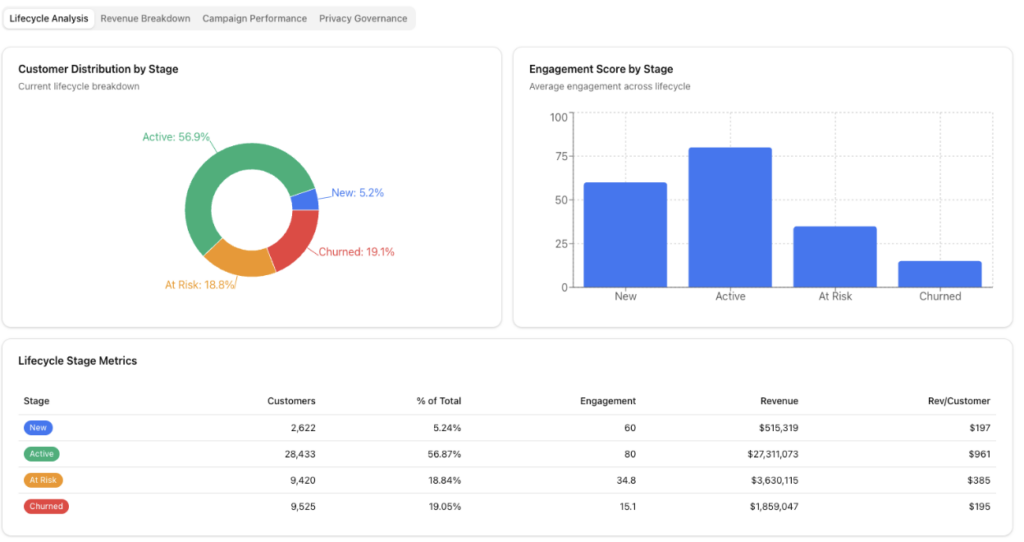
- Lifecycle Segmentation: Identify where customers are in their journey (acquisition, activation, growth, retention, at-risk)
- Engagement Scoring: Quantify customer health based on product usage, support interactions, and transaction patterns
- Churn Risk Prediction: Identify disengagement signals before customers leave
- Cross-Sell Opportunity Detection: Surface expansion opportunities based on usage patterns and lifecycle stage
- Revenue Attribution: Connect marketing activity directly to customer lifetime value

- Activation – Enabling Operational Execution: Intelligence that stays in dashboards doesn’t drive results. We enable teams to act:
- Marketing teams execute targeted campaigns based on lifecycle segments
- Customer success teams receive early warning alerts for at-risk customers
- Product teams understand feature adoption patterns by lifecycle stage
- Executives track lifecycle health metrics tied directly to revenue outcomes
How: Building Customer Lifecycle Intelligence
The Implementation:
We build Customer Lifecycle Intelligence Platforms on Snowflake’s Data Cloud, leveraging modern cloud data architecture to unify and operationalize customer data:
Unified Customer 360 Data Foundation: We create a comprehensive customer data model that brings together:
- Transactional Data: Purchase history, product subscriptions, transaction values, payment methods
- CRM Data: Account details, contact information, communication preferences, relationship history
- Marketing Data: Campaign engagement, email opens, ad clicks, attribution touchpoints
- Product Usage Data: Feature adoption, session frequency, depth of engagement, user flows
- Support Data: Ticket history, resolution times, satisfaction scores, support channel preferences
Identity Resolution & Data Governance: We ensure data quality and privacy:
- Resolve customer identity across systems to create consistent profiles
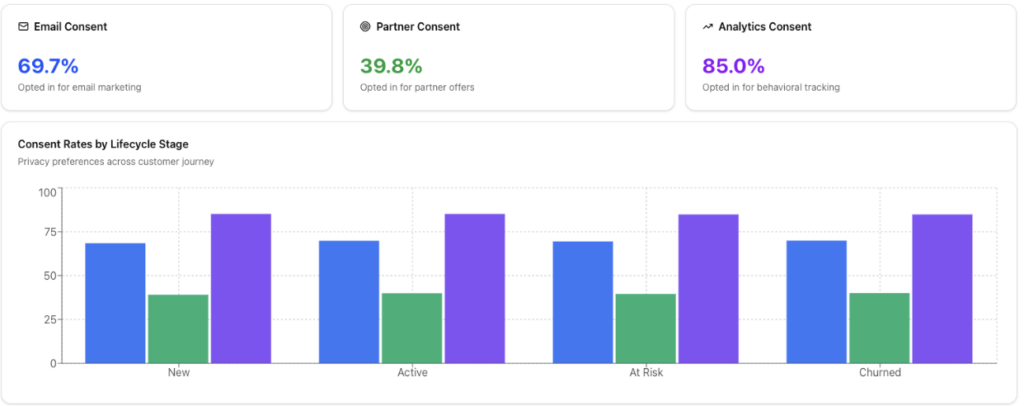
- Implement role-based access controls to protect sensitive customer data
- Apply data masking and consent tracking for privacy compliance
- Build audit trails for regulatory requirements
- Establish data lineage from source systems to insights
Lifecycle Intelligence Models: We deploy analytics that generate actionable insights:
Lifecycle Segmentation Models
- Classify customers by journey stage: new user, activated, engaged, power user, at-risk, churned
- Track lifecycle progression and identify bottlenecks in the customer journey
Engagement Scoring
- Quantify customer health using product usage, transaction frequency, and support interactions
- Create early warning systems for declining engagement
Predictive Analytics
- Churn risk modeling that identifies customers trending toward disengagement
- Cross-sell propensity scoring that surfaces expansion opportunities
- Lifetime value prediction to prioritize high-value customer segments
Operational Dashboards & Activation: We create role-based intelligence interfaces:
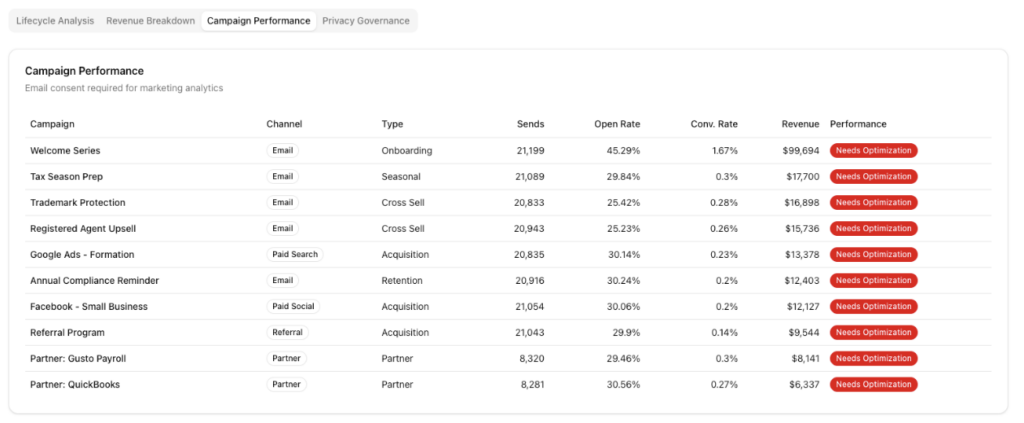
Marketing Team Dashboards
- Lifecycle segment performance and campaign effectiveness
- Attribution analysis connecting marketing touches to revenue outcomes
- Audience building tools for targeted lifecycle campaigns
Customer Success Dashboards
- At-risk customer alerts with recommended intervention strategies
- Engagement trend analysis by customer segment
- Health score tracking and proactive outreach queues
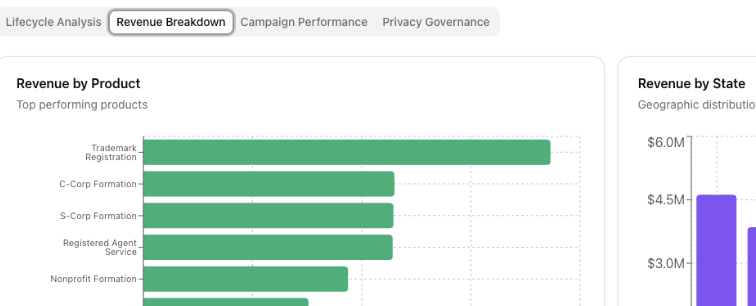
Executive Dashboards
- Customer lifetime value trends and cohort analysis
- Lifecycle health metrics by product line and segment
- Revenue attribution and marketing ROI by lifecycle stage
Snowflake Cortex-Powered Development: We leverage Snowflake Cortex Code to:
- Rapidly develop data models within the Snowflake ecosystem
- Build application interfaces that embed analytics into workflows
- Create scalable data pipelines that normalize customer datasets in real time
- Enable self-service analytics for business users
The Impact: Measurable Business Results
These transformations deliver quantifiable improvements across the customer lifecycle:
✓ Improved Lifecycle Visibility
- Every team operates from the same unified customer view
- Lifecycle stage progression tracked in real time across the platform
✓ Targeted Marketing Campaigns
- Lifecycle segmentation and engagement scoring enable precision targeting
- Marketing spend allocated to highest-value opportunities
✓ Proactive Retention Strategies
- Early identification of churn risk enables intervention before customers leave
- Customer success teams prioritize outreach based on risk scores
✓ Revenue Attribution Clarity
- Direct connection between marketing performance and revenue outcomes
- Data-driven budget allocation decisions
Measurable Target Outcomes:
- Up to 15% increase in customer lifetime value through better targeting and retention
- 20% improvement in repeat purchases via proactive engagement strategies
- 10% lift in cross-sell conversion rates through opportunity identification
The Bigger Picture
This approach represents a fundamental shift from static reporting to operational customer intelligence. By unifying fragmented data, applying lifecycle analytics, and enabling team activation, digital platforms move from guessing about customer needs to knowing – and acting on – precise insights.
Customer Lifecycle Intelligence Platforms don’t just improve metrics – they transform how organizations grow. Marketing teams shift from broad campaigns to precision targeting. Customer success teams shift from reactive support to proactive retention. Executives shift from intuition-based decisions to data-driven strategy. And the entire organization aligns around a single, consistent view of customer value.
Ready to transform fragmented customer data into unified lifecycle intelligence? Let’s talk about how evolv can help you build the platform that unlocks customer lifetime value and drives sustainable growth. You can also check out our Service Catalog Offering to find out more about the specific solutions capabilities to support you on your journey.

Mike Henry is a consulting leader at evolv who helps organizations turn data and AI initiatives into practical business outcomes. He leads the firm’s Diversified Portfolio, partnering with companies across industries to identify opportunities where modern data platforms and AI can accelerate growth, reduce complexity, and improve decision-making.
Prior to evolv, Mike spent more than fifteen years leading large consulting engagements at Accenture and Valtech, managing various accounts and cross-functional teams delivering complex digital and cloud initiatives. Based in Colorado, Mike enjoys spending time outdoors with family, friends, and his two dogs when he’s not working with clients.