In the first session I attended at the Society of Petroleum Engineers Annual Technical Conference and Exposition (ATCE) this year, an engineer from the Abu Dhabi National Oil Company (ADNOC) answered a question that ended up explaining most of what I heard over the rest of the conference.
The team had just presented the first AI-APC autonomous gas lift optimization system, deployed across hundreds of strings.1 I asked whether more of their effort went into getting the data into a usable format or into building and tuning the model.
The answer wasn’t close.
The majority went into preparing the data. They hired entire teams assigned to each data source, one for the well site, one for the field, one for the historian. Without governance, roles and responsibilities, and data assurance standards established first, the speaker said, they could not have built the model at all.
What stayed with me was not the answer itself but how often the same theme resurfaced, in technical presentations and executive panels alike. Autonomous optimization, AI ROI, governance, board-level decision making: the limiting factor was rarely the model. It was everything underneath it.
AI is no longer a separate conversation
Of the 63 technical and strategic sessions on the ATCE 2026 program, 17 explicitly referenced artificial intelligence, machine learning, data or digital systems in the title. Twelve of 46 technical sessions, one of five strategic panels, four of twelve special sessions. Count autonomy, automation and probabilistic analytics as well and the number is 23.
The placement matters more than the count. AI appeared in sessions on HSE, fracturing, reservoir modeling, unconventionals, production optimization, CCUS, subsurface characterization, well design, data acquisition, asset management, forecasting and drilling. It was not confined to a digital track or an innovation track. It was embedded in the core technical program.
The use cases under discussion were practical and operational:
- Autonomous gas lift optimization
- ESP optimization
- Predictive maintenance
- Land and contract document intelligence
- Engineers deploying AI agents inside their own workflows
Very little of the conversation was about whether AI works. Most of it was about where it creates value, how to measure that value, and how to govern it.
For an industry with a reputation for cautious adoption, that is a meaningful shift, and it is happening faster than most operators have accounted for.
The constraint is the measurement layer, not the model
The clearest technical theme of the conference was how consistently operators ran into the same limitation, and it was never the algorithm. It was measurement quality.
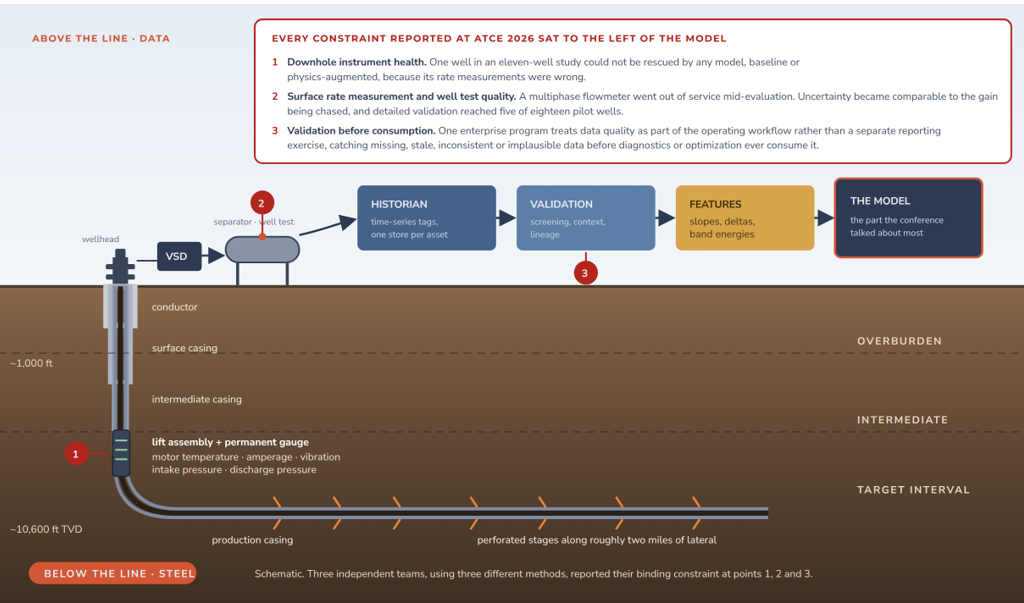
ADNOC’s system continuously identifies optimal gas lift injection rates while operating within reservoir, integrity and facility constraints, and can optimize for maximum production, minimum gas lift consumption or overall efficiency using real-time data from field systems and historians. In one case, production increased 3.8 percent after lift gas was redistributed to bring three newly commissioned wells online.1
The more useful part of that presentation was the discussion of limits.1 The team described problems familiar to most production engineers:
- Slow well response after an operating change
- Incomplete lifecycle characterization of well behavior
- Continual discovery of edge cases requiring retraining
- Measurement uncertainty comparable in magnitude to the benefit being measured
During the evaluation a multiphase flowmeter was out of service. The resulting uncertainty made it difficult to quantify the improvement with confidence, and detailed validation was ultimately performed on five of the eighteen pilot wells.1
The counterpoint came from the University of Oklahoma, whose presentation asked whether physics-based simulation can compensate for gaps in field data. The answer was only partly.
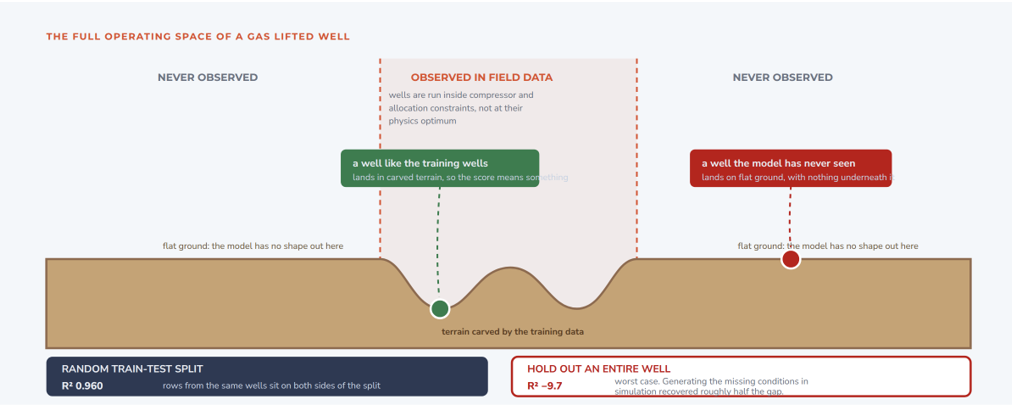
Under a conventional train-test split their model reached an R2 of 0.960. Hold out an entire well and performance collapsed, with one case falling to negative 9.7. The problem was not model architecture. It was coverage. Real wells operate inside compressor, allocation and facility constraints, so much of the theoretical operating space is never observed. Generating the missing conditions in simulation recovered roughly half the gap. One well remained problematic because its underlying rate measurements appeared incorrect, likely flowmeter error, and no modeling approach recovered from that.2
The enterprise program I read afterward reaches the same place from the opposite direction. It treats data quality as part of the operating workflow rather than as a separate reporting exercise, with validation that catches missing, stale, inconsistent or implausible data before diagnostics or optimization ever consume them.3 That is a design decision about where screening sits, not a dashboard.
Two very different studies, one conclusion. If you cannot describe the health of your instrumentation and the quality of your well tests, the model is probably not your primary constraint.
AI spend is now competing with capital
The most consequential shift discussed in the leadership sessions had little to do with technology. It was about capital allocation.
Oxy described bringing finance into AI discussions far earlier than in previous years, because AI initiatives now compete for the same funding as capital projects. Once AI spending moves out of an innovation budget, it has to clear the same economic hurdle as every other investment on the table.
Exxon made a similar case from a different angle, arguing for concentration on high-value operational problems where outcomes can be measured and demonstrated, rather than broad deployment. Both executive panels independently landed on the same advice: be surgical, and do not let a thousand flowers bloom.
Several related observations reinforced the theme. Exxon described the growing difficulty of synthesizing multiple operational metrics into a coherent business decision, a job that now falls to middle management and above. Oxy raised the quantification problem created by their own success, where adoption has spread through individual agents and workflow-level productivity gains that resist clean measurement. Quorum argued for continuous monitoring of accuracy rather than periodic validation exercises, and for auditing where numbers come from as more analysis gets generated across more teams. StrandBlue noted that AI programs tend to expose data and organizational silos that were already there, which forces process redesign rather than simple automation.
The most direct comment came from Exxon: most failed efforts start as science projects that never scale. The line most likely to end up in 2027 planning documents came from the same session, and deserves to. Don’t do AI just for the sake of AI.
The question is no longer whether AI can create value. It is where it creates enough value to justify the investment.
Operations and the board read the same data differently
One observation from Chevron stayed with me. Operations teams use data to make the decisions in front of them today. The board uses much of that same data to understand where the company is headed over the next three to five years. Same information, different decisions, different time horizons, and a translation layer between them that mostly does not exist as a system.
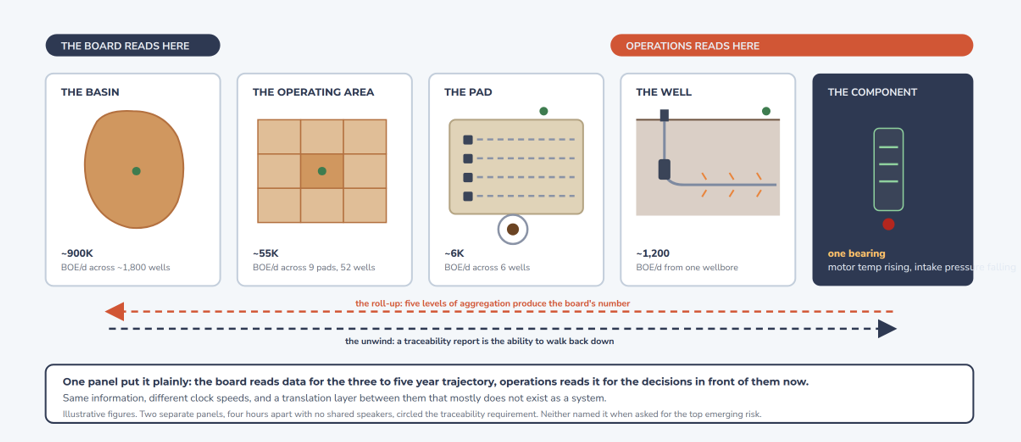
That distinction surfaced repeatedly in the discussions of governance and executive decision making. Production operations was consistently identified as one of the fastest paths to AI value, with production optimization and decline-rate reduction the common priorities.
Asked about emerging risks, the panel was unanimous and immediate: cybersecurity.
Another topic ran through both sessions without ever being categorized as a risk. Traceability.
Questions about AI accountability and traceability came up independently in both rooms, four hours apart, among different speakers from different companies. The concern was straightforward. Executives are increasingly asked to approve multi-million and in some cases billion dollar decisions supported by AI-generated analysis, while the context behind those recommendations does not travel with the output.
What follows from that is concrete enough to build against. Decision makers should be able to trace an important metric back to its source, understand how it was calculated, and independently validate the conclusion.
Two separate panels circled that requirement on the same day, and neither named it when asked for the top risk. That gap may prove more important than any individual technology discussed at the conference.
Experience is still the training set
The most memorable comment I heard in the leadership sessions was not about AI at all. It was about people.
AI systems learn from current operations. They learn from decisions made by experienced engineers, operators, geoscientists and asset teams. If that expertise does not transfer to the next generation, and firms lean on systems integrators to carry the knowledge instead, organizations risk losing the very thing their future systems depend on. One panelist took it further than I expected: past a certain point this stops being a question of best practice and becomes a question of safety, security and financial integrity.
The technical sessions reinforced that without setting out to. Despite the word autonomous appearing in the title of ADNOC’s deployment, engineers remain deeply involved in defining the models, the operating limits, the constraints and the approved control actions, and the control system executes inside boundaries that people set. By the presenters’ own account, the hardest part of implementation was not the algorithm. It was aligning petroleum engineering, reservoir management and operations around an acceptable operating envelope for each well.1
The Oklahoma work highlighted a different side of the same relationship. Their method generated the most value in wells with sparse, limited or unusual operating histories, which are precisely the wells where engineers have the fewest comparable observations to work from.2 Where experience is deep and data is abundant, AI offers incremental gains. Where uncertainty is highest, it offers the most help. Neither replaces the other.
What I would do Monday morning
If I were evaluating AI initiatives in production operations today, I’d have four priorities:
- Audit instrumentation before scoping the model. Presentation after presentation showed the binding constraint to be measurement quality rather than model performance. Flowmeters, well tests and data quality processes deserve at least as much attention as algorithms.
- Bring finance into the discussion earlier. If AI investment is competing with capital expenditure, and at most operators it now is, the ROI case has to be built at the start rather than justified at the end.
- Focus on a small number of measurable use cases. Both executive panels independently argued for targeted investment over a broad collection of loosely connected pilots.
- Establish traceability now. If a recommendation is important enough for executive review, leadership should be able to see where it originated and how it was produced.
Where this leaves us
The common thread across every session was not AI itself. It was trust in the data beneath it.
The operators presenting the strongest results had invested in governance, measurement quality, operational ownership, lineage and validation long before they were discussing models. Those capabilities are far less visible than an AI application, and they were consistently what produced the outcomes that drew attention.
That layer is the work we do at evolv. A production data model that holds the relationships between wells, completions, equipment and tests, so context travels with the measurement instead of being reconstructed by an engineer every morning. Validation applied inside the operating workflow rather than as a reporting exercise. Lineage that lets you trace a number on a board slide back to the instrument that produced it. On Snowflake, that means Horizon for governance and lineage with Cortex for the AI layer above it.
ATCE 2026 left me with one unanswered question. Most operators seem aligned on production operations as the near-term opportunity. What use case feels like a moonshot today but becomes mainstream within the next five to ten years? I would be interested to hear where others place their bets.
And if you are being asked to put an AI number in front of a board next year and you are not certain you could defend where it came from, that is the conversation I would want to have.
Can your production numbers survive an audit? Connect with evolv.

Griffen Livermore is a management consultant at evolv Consulting with seven-plus years across energy, software, and manufacturing. He spent five years in upstream and midstream oil & gas, implementing enterprise systems and leading the asset-data conversions behind acquisitions totaling more than $5 billion in announced transaction value – from corporate accounting, land, and revenue systems to on-site field work. At evolv, he delivers data & AI solutions across the firm’s Snowflake partner ecosystem: program leadership, executive reporting, and the AI-powered tooling that moves solutions from pitch to production. A Society of Petroleum Engineers member based in Houston, Griffen helps energy organizations put AI to work in real operations.
Sourcing
One attendee, one day, three of 63 sessions: Production Optimization, Unlocking ROI of AI in Energy, and From Operations to the Boardroom.
Two papers cited here were presented in the technical session, and I have checked what I heard against the published versions: SPE 233953 from ADNOC and SPE 233800 from the University of Oklahoma. One I read afterward and did not see presented, SPE 234113 on ADNOC’s enterprise digital twin program. Where my notes differ from the published papers, I have gone with the papers. Panel remarks are paraphrased from my notes and attributed at company level. If you were on either panel and I have misrepresented you, tell me and I will correct it.
The three figures are original artwork. The data points shown in them are drawn from the papers cited below.
I attended ATCE as a delegate rather than in connection with any client engagement. Every company named here presented publicly at the conference, under its own name, on the published program. Nothing in this piece is written on their behalf or endorsed by them, and the observations are my own.
Citations
1 Rubio, E., Gupta, G., Subaihi, M., and R. Mohan. “From Manual to Autonomous: Field Experience and Lessons Learned from Implementing the First AI-APC Autonomous Gas-Lift Optimization Solution.” Paper presented at the SPE Annual Technical Conference and Exhibition, Houston, Texas, USA, October 2026. doi: https://doi.org/10.2118/233953-MS
2 Al Raisi, A. F., Karami, H., and D. Devegowda. “Gas Lift Evaluation and Production Forecasting Through a Transfer Learning Dual-Track Machine Learning Framework.” Paper presented at the SPE Annual Technical Conference and Exhibition, Houston, Texas, USA, October 2026. doi: https://doi.org/10.2118/233800-MS
3 Mohan, R., Muhairi, S. Al, Hashemi, M. Al, Alsereidi, A., Almenhali, M., Chennallour, S., Alawadhi, S., Tambunan, D., Alansaari, M., Alzaabi, A., Alhashmi, S., and R. Alhammadi. “AI Enabled Digital Twins Enabling Integrated Production Optimization and Autonomous Operations.” Paper presented at the SPE Annual Technical Conference and Exhibition, Houston, Texas, USA, October 2026. doi: https://doi.org/10.2118/234113-MS