

by Habby Bauer
Trust shapes how consumers transact, how merchants participate in digital commerce, and whether customers return after something goes wrong. Yet the teams responsible for protecting that trust are still commonly evaluated through fraud losses, dispute volumes, processing costs, and productivity. Those measures are essential, but incomplete.
The economic stakes are substantial. U.S. consumers reported more than $12.5 billion in fraud losses in 2024, up 25% from 2023, according to the Federal Trade Commission. These reports span many types of fraud; they are not a proxy for payment disputes or institutional losses. They nevertheless underscore the cost of eroded confidence.
Protection Services should be managed as a measurable source of customer and enterprise value, not simply as a cost of doing business.
The opportunity for financial institutions and payments businesses is to quantify what protection contributes, identify the drivers of that value, and optimize the balance among trust, growth, risk, and cost.
Protection is an economic proposition
Protection gives buyers confidence that legitimate problems will be resolved, provides merchants with greater transaction predictability, and helps platforms build lasting relationships. Its value may show up in avoided losses, stronger conversion, improved retention, fewer preventable disputes, and lower cost to serve. Some benefits are direct and readily observable; others require careful attribution.
This changes the executive question from “How much does protection cost?” to “What incremental value does protection create, for whom, and at what cost?” It also changes the decisions leaders can make: which customer experiences to improve, which risk controls to strengthen, and where an additional dollar of investment delivers the greatest return.
A common language for protection value
A practical measurement model connects four dimensions: customer trust and experience; commercial and economic value; risk and dispute effectiveness; and operational and data efficiency. Each reveals a different aspect of performance, and none should be optimized in isolation.
A reduction in claims may look attractive until it is accompanied by legitimate customers abandoning the process. A tighter fraud control may lower losses while increasing false declines. Faster case handling may save labor but generate more rework or inconsistent outcomes. A useful framework makes these trade-offs visible.
Protection-adjusted economic value = attributable incremental contribution margin + avoided fraud and dispute losses + avoided operating costs − program costs − incremental customer friction costs.
This is a management construct, not an accounting standard. Its credibility depends on defined baselines, causal testing where feasible, consistent cost allocation, and safeguards against double-counting. The aim is not a deceptively precise single number; it is a decision-quality view of the economics.

Disputes are intelligence, not just workload
The case for rethinking disputes is becoming more urgent. Mastercard and Datos Insights projected global chargeback volume of approximately 261 million in 2025, rising to 324 million in 2028, roughly 24% growth. This forecast concerns card chargebacks, not every form of payment-platform dispute, but it highlights the limits of a strategy centered only on processing more cases faster.
A dispute may reflect an unauthorized payment, account takeover, an item not received, goods materially different from their description, confusing billing information, or deliberate misuse of protection rules. These situations may enter the same operational queue, but they do not share a root cause or an optimal remedy.
Institutions should distinguish the customer-reported reason, the evidence-supported root cause, the disposition, and the preventability of each case. This turns disputes into a source of insight about product experience, merchant behavior, transaction transparency, risk decisions, and process failures.
The most effective dispute strategy combines prevention, clear explanation, fair resolution, appropriate recovery, and learning. It asks not only how to reduce cost per case, but which cases should never have occurred, and which interventions preserve legitimate recourse while preventing recurrence.
First-party misuse requires a more nuanced response
A legitimate transaction can be disputed because a customer does not recognize a descriptor, forgets a subscription, misunderstands fulfillment, or believes an issue must be escalated to receive help. Other cases involve intentional exploitation of protection policies. Treating both as “friendly fraud” obscures the distinction between confusion and abuse.
That distinction has practical consequences. Intentional misuse may warrant targeted controls, stronger evidence, and policy enforcement. Unintentional confusion is often better addressed through recognizable transaction details, timely notifications, accessible merchant communication, and clearer resolution pathways.
Behavioral design should be tested rather than assumed effective. Experiments can measure whether a message, transaction detail, or self-service step reduces avoidable disputes without deterring valid claims. Success requires both economic results and customer-fairness guardrails.
Measure outcomes, then the drivers behind them
A protection scorecard should have three levels: enterprise outcomes, protection performance, and operational drivers. The top level establishes the economic contribution; the middle level shows the customer and risk outcomes; the bottom level explains what leaders can change.
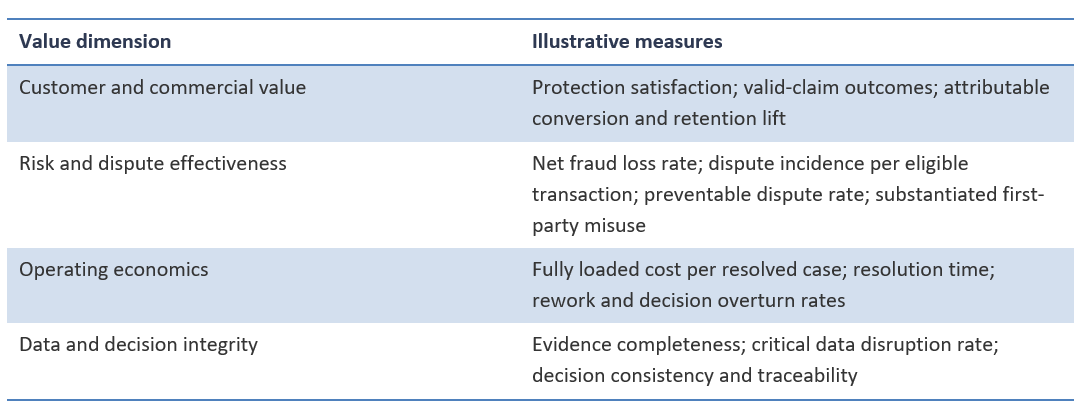
The scorecard should be intentionally small. Every metric needs an owner, denominator, definition, refresh cadence, and a clear decision it informs. Where outcomes such as conversion or retention are attributed to protection, organizations should use experiments or defensible counterfactual methods rather than infer causality from correlation.
Data and AI must improve decisions, not just throughput
Protection operations rely on transaction records, customer interactions, merchant evidence, fraud signals, and case-management systems. Inconsistent definitions or missing evidence can distort both individual decisions and the executive view of performance. Data disruption has a real cost: rework, remediation, avoidable losses, delayed resolution, and customer friction.
Reliable data is therefore a business requirement. Evidence completeness, lineage, consistent classifications, and decision traceability should be measured alongside traditional operational KPIs. Without them, neither value attribution nor responsible automation is credible.
AI can strengthen detection, classify issues, assemble evidence, identify recurring causes, and assist caseworkers. But automation volume is not a measure of success. The test is whether it improves decision accuracy, fairness, economics, and experience. Human oversight and effective escalation remain essential where decisions affect customers’ access to protection.
Make value measurement an operating discipline
The starting point is a focused Protection Value Diagnostic: agree on the outcomes protection is meant to deliver; assess current measurement integrity; segment disputes and losses by evidence-supported cause; quantify the largest sources of avoidable friction and expense; and prioritize interventions by expected value, feasibility, and risk.
From there, management can move through a repeatable cycle: define value, establish baselines, diagnose opportunity, test interventions, and scale what works. A common scorecard should connect policy, product, risk, operations, and data teams to the same outcomes, with explicit accountability for both economic benefit and customer fairness.
The result is more than improved reporting. It is a way to decide where to invest, when to change policy, how to evaluate technology, and how to know whether a better operational metric actually produced a better business outcome.
From the cost of protection to the value of trust
The next generation of Protection Services leaders will not be defined solely by how little they spend, how many disputes they close, or how many decisions they automate. They will be defined by their ability to show, with credible evidence, how protection strengthens customer confidence and commercial performance while managing risk and cost.
Trust is an economic asset. Protection value measurement is how institutions begin to manage it deliberately.
At Evolv Consulting, we believe this shift requires more than technology: a shared language for value, trusted data, rigorous measurement, and an operating model that connects strategic priorities to measurable outcomes. Connect with us today.

Habby Bauer is a financial services and technology executive at evolv Consulting, focused on helping organizations translate data, AI, and technology investments into measurable business outcomes. Her work spans strategic partnerships, business transformation, and growth across the financial services ecosystem.