

In the world of mission-critical infrastructure (think: hyperscale data centers, AI computing environments, and edge deployments) uptime is non-negotiable. A single outage can cascade into millions of lost dollars and cause irreparable damage to customer trust.
Despite this risk, many organizations managing critical infrastructure are still operating with one hand tied behind their back, undertaking maintenance reactively using fragmented data and disconnected systems instead of utilizing a more proactive approach.
For our clients in critical infrastructure management, the challenge is clear. As demand for AI infrastructure accelerates and SLA requirements become more stringent, the gap between reactive service operations and the predictive intelligence needed to stay ahead is widening. Here is how evolv is helping infrastructure leaders transform scattered data into proactive, AI-driven service prioritization that protects uptime, improves margins, and unlocks new revenue.
A quick note before we dive in: A video embedded in this post provides a quick look at how evolv leverages Snowflake Cortex Code to spin up business outcomes quickly for our clients. We can deliver a true demonstration of tailored solutions just like this to solve your business problems. If you like what you see, reach out!
Why: The Hidden Cost of Reactive Service
The Problem: For many infrastructure providers, critical service and telemetry data exist across disconnected systems – IoT platforms, service ticketing systems, warranty records, ERP, CRM, and field service management tools. This fragmentation creates operational blind spots, including:
- Reactive Dispatch Decisions: Technicians deployed based on ticket urgency, not asset risk;
- No Systematic Risk Prioritization: High-risk assets are not identified before they fail;
- Predictive Insights Trapped in Silos: Data exists but is not embedded into technician workflows;
- Limited Asset Intelligence: Warranty status, service history, and telemetry are not unified;
- Emergency-Driven Operations: Fighting fires instead of preventing them
These gaps are not just operational inefficiencies; they are direct threats to business performance. Emergencies drive up costs, since responding to them typically requires expediting parts and relying on premium labor. Reactive work erodes profitability and leads to limited recurring revenue growth. In zero-tolerance environments, failures also trigger financial penalties and contract risks. And reactive models just plain fall behind, as many competitors are already using embedded AI in their service operations to gain a competitive advantage.
Moving from reactive maintenance to predictive service prioritization – powered by unified data and embedded intelligence – is now an imperative, and evolv stands ready to help guide companies through this transition.
What: Unified Asset Intelligence for Predictive Service
evolv designs predictive service prioritization platforms that unify fragmented asset data and embed intelligence directly into field service workflows. Rather than treating systems in isolation, we create a unified asset lifecycle intelligence layer that brings together:
- IoT telemetry and sensor data
- Service ticket history and resolution patterns
- Warranty records and coverage status
- SLA thresholds and penalty exposure
- ERP, CRM, and field service management data
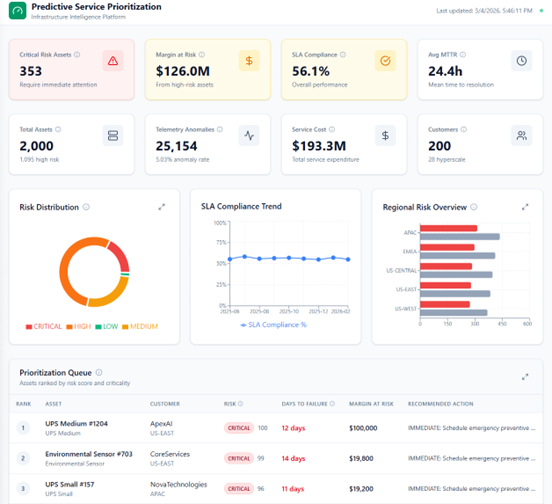
Our platforms do not just collect data – they generate actionable intelligence by utilizing AI models that identify high-risk assets before failure. Those assets are ranked by failure probability, SLA impact, and service margin to create patterns that are mapped to current telemetry signals.
An early warning system is then embedded directly into dispatch and technician workflows like mobile applications, providing teams with proactive alerts about potential issues and recommended steps to address them before failures happen. Executive dashboards, meanwhile, track SLA compliance, MTTR, and service margins, and automated alert systems trigger warnings when assets are headed toward failure.
How: Delivering Predictive Service Intelligence
evolv follows a four-phase approach that delivers measurable value at each stage:
Phase 1: Discovery & Data Profiling: We start by understanding your current state, including assessing data quality across IoT, service, warranty, and operational systems. Our teams normalize asset identifiers to create a single source of truth, establish baseline KPIs, identify quick wins, and prioritize high-value use cases.
Phase 2: Unified Data Foundation: Next, we build the infrastructure for predictive intelligence by creating a normalized asset semantic layer that unifes disconnected systems, along with scalable ingestion and transformation pipelines that support real-time and historical analytics. We integrate IoT telemetry, service tickets, warranty data, ERP, CRM, and field service management platforms, and establish data governance and lineage for audit and compliance.
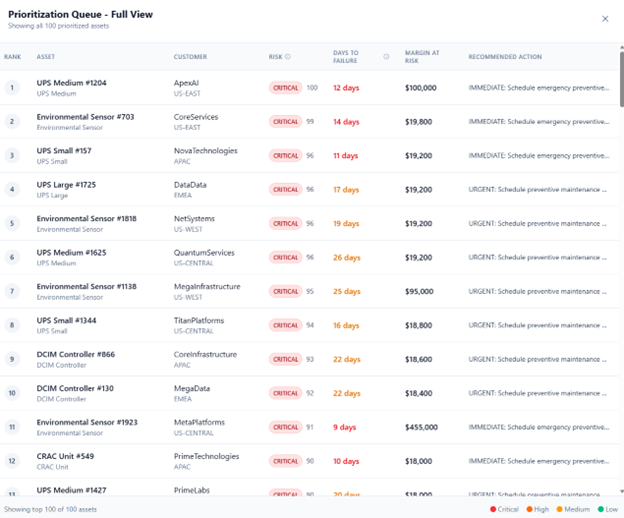
Phase 3: Predictive Intelligence Layer: In this phase, evolv deploys AI-driven risk scoring and prioritization by developing explainable risk scoring models using telemetry patterns and service history; creating service prioritization algorithms that balance failure risk, SLA exposure, and technician availability; and building failure prediction models that identify assets trending toward critical thresholds. All of this generates proactive maintenance recommendations that come with clear business justification.
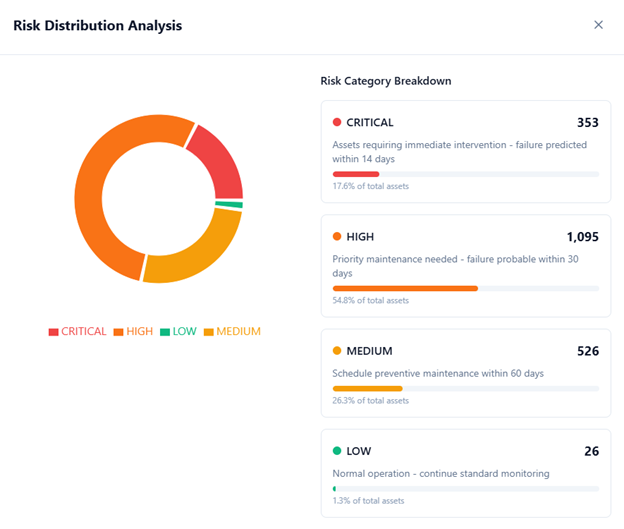
Phase 4: Workflow Operationalization: Finally, we embed intelligence into daily operations by deploying service prioritization dashboards for dispatch teams and integrating risk alerts directly into field service management systems. Technicians receive mobile-friendly asset intelligence and recommended actions, and executive dashboards track SLA compliance, service margin, and installed base revenue.
evolv utilizes an agile delivery model in our work, an iterative approach that includes pilot development, allowing us to measure impact before scaling and validate stakeholder concerns at each phase. All this information allows for continuous refinement based on real customer feedback and enables measurable success criteria at each milestone.
The Impact: Measurable Business Results
Moving from a reactive-to-proactive maintenance model delivers clear, quantifiable operational and financial improvements.
High-risk assets are prioritized before they fail, converting expensive emergency calls into planned maintenance and lowering supply costs. Labor costs are better optimized, and overtime expenses are reduced. Penalty exposure risks also are reduced, as teams can proactively address at-risk assets before SLA breaches take place.
This strategy also enables recurring service revenue through proactive lifecycle management. Teams can identify upsell opportunities based on asset age, utilization, and warranty status. And all that embedded intelligence provides organizations with an AI-driven competitive advantage.
Predictive service platforms do not just reduce costs – they create strategic advantages. Customers trust that uptime is protected. Service teams trust the risk scores driving their priorities. Executives trust that margins are improving and SLA exposure is declining. And the business scales AI-enabled growth on a foundation of unified asset intelligence.
Ready to transform your service operations from reactive to predictive? Let’s talk about how evolv can help you build the unified intelligence platform that protects uptime and unlocks service revenue growth. You can also check out our Service Catalog Offering to find out more about the specific solutions capabilities to support you on your journey.

Hillary Rodgers is a principal and client partner at evolv. She has more than 15 years of experience as a Management and Technology Consultant, along with managerial and leadership experience for teams of up to 50 people. Hillary has extensive expertise in IT strategy, enterprise IT transformation, agile program management, process optimization, end-to-end solution implementation, and vendor relationship management across multiple industries including airline, high-tech automotive, energy and utilities, healthcare, and state and local government.